

Blog
RFID Card Dispenser Guide: Automated Card Issuing Solutions for Self-Service Kiosks
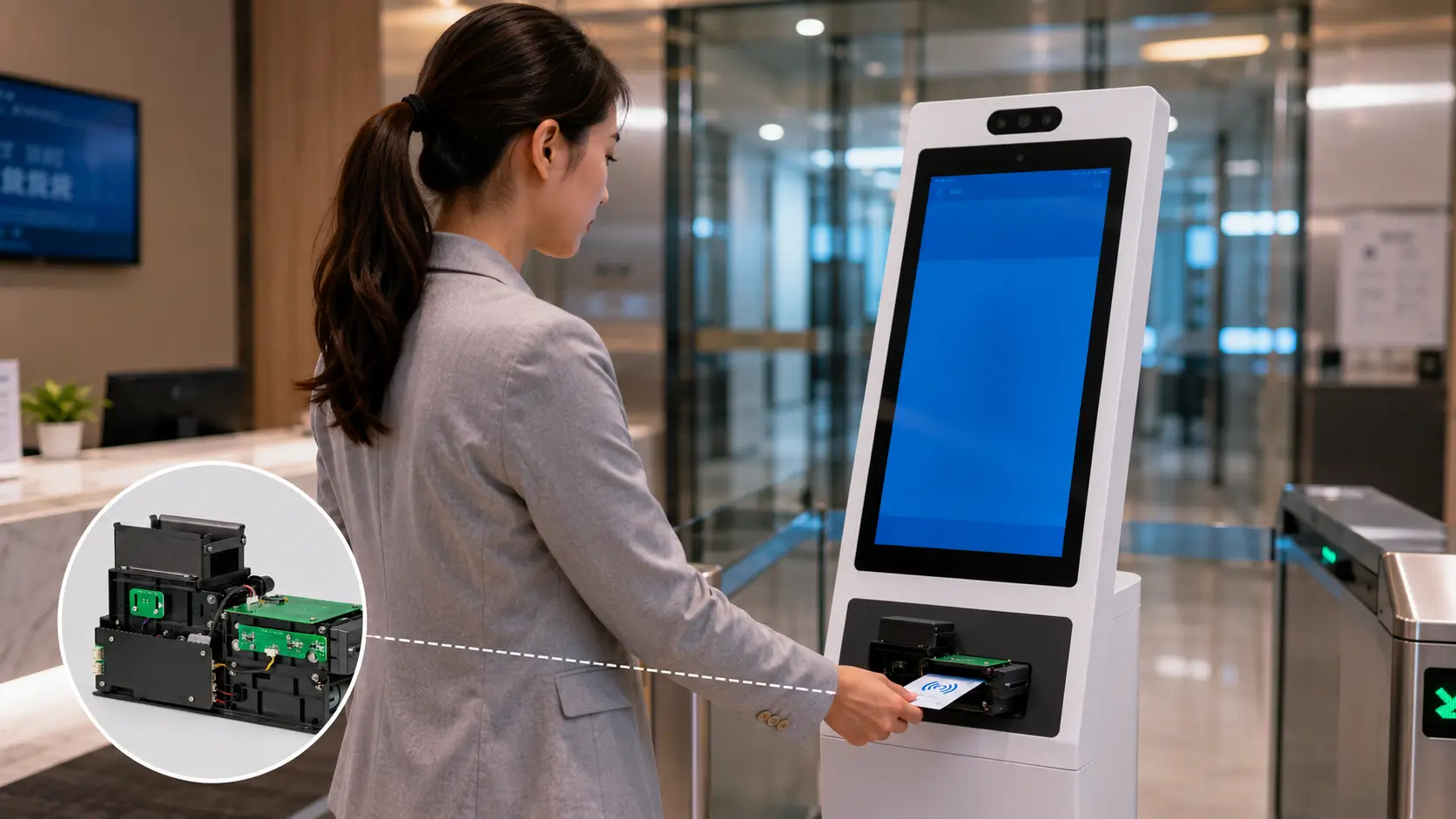
RFID card dispensers are becoming an important hardware component in modern self-service systems.
From hotel self check-in kiosks to access control terminals, visitor management systems, smart lockers and membership platforms, organizations increasingly use automated card issuing solutions to reduce manual operations and improve user experience.
However, selecting the right RFID card dispenser is not only about RFID compatibility.
System integrators and kiosk manufacturers also need to consider card storage capacity, card thickness, dispensing reliability, integration method, software compatibility and long-term maintenance requirements.
A well-designed RFID card dispensing system must work together with the complete self-service workflow, including kiosk software, embedded controllers, RFID readers or encoders, and user interaction processes.
This guide explains how RFID card dispensers work, where they are used, what factors should be evaluated before selection, and how system integrators can choose the right solution for different self-service applications.
For system integrators looking for a complete overview of automated card issuing solutions, the SNRO Card Dispenser Hub provides structured resources covering RFID card dispensers, motorized card dispensers, multi-hopper solutions, integration guides and application references.
It is designed for:
- Self-service kiosk manufacturers
- System integrators
- Access control solution providers
- Hotel technology companies
- Smart locker developers
- OEM terminal builders
The goal is not only to select a card dispenser that can issue cards, but to select a reliable hardware platform that can operate consistently after deployment.
Quick Answer: What Is An RFID Card Dispenser?
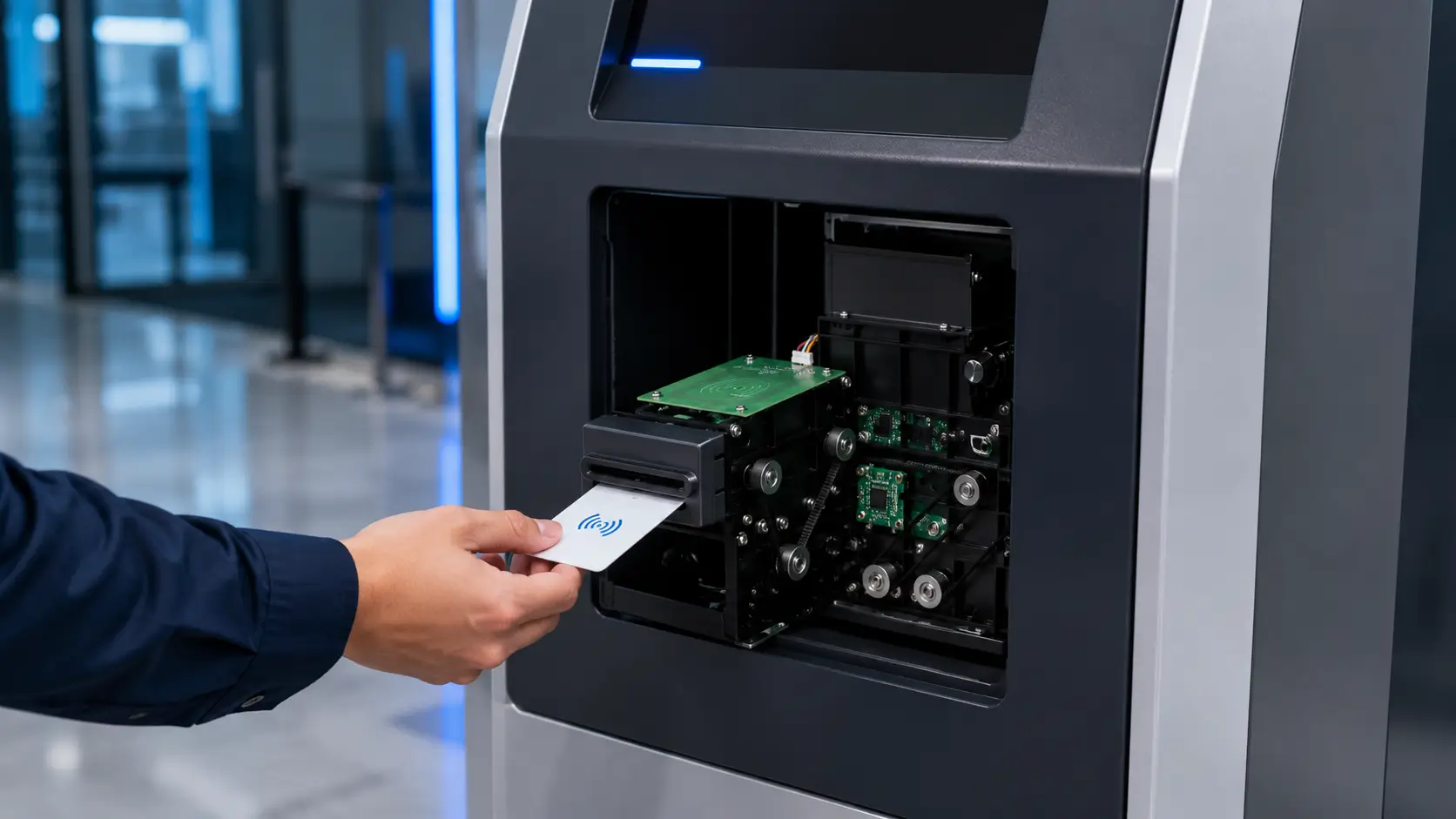
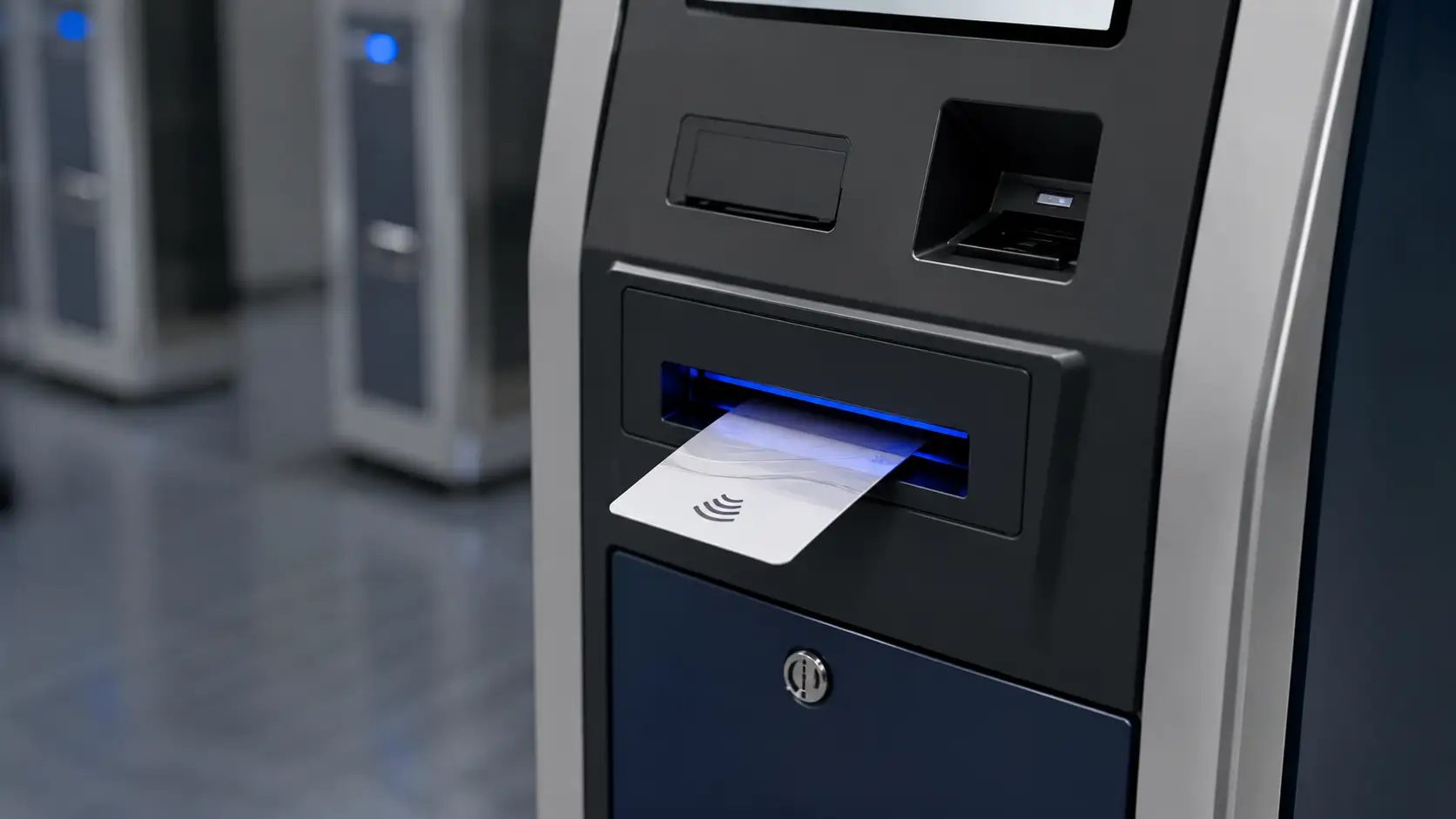
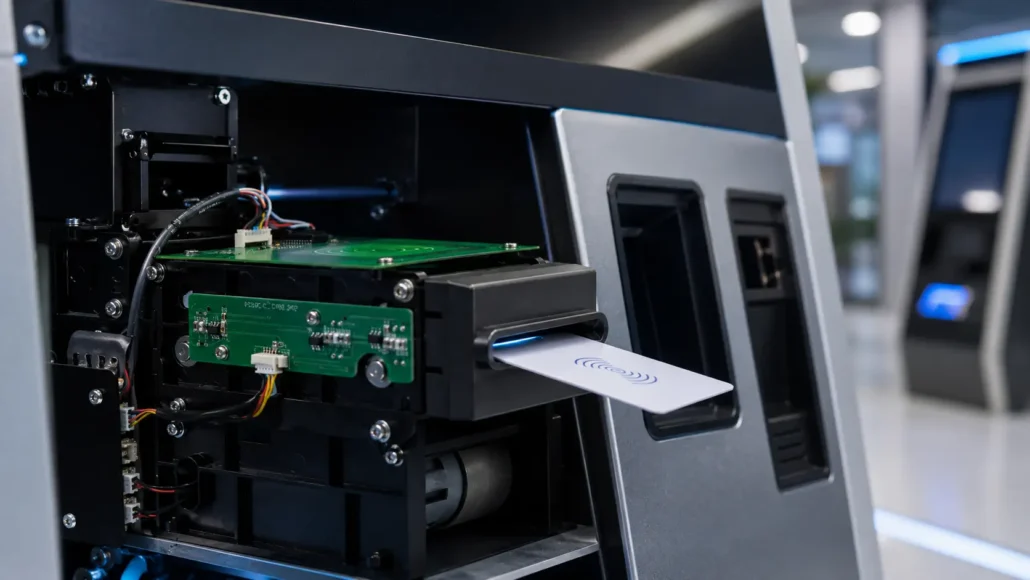
An RFID card dispenser is an automated kiosk component that stores, detects and issues RFID cards without manual assistance.
It is commonly integrated into self-service terminals for:
- Hotel key card issuing
- Access control systems
- Visitor management kiosks
- Smart lockers
- Membership programs
- Automated credential distribution systems
A suitable RFID card dispenser should be evaluated based on:
- RFID card compatibility
- Card thickness and material
- Hopper capacity
- Dispensing reliability
- Card collection method
- SDK and communication interface
- Kiosk integration requirements
For professional self-service projects, an RFID card dispenser is not only a card feeding device.
It is part of the complete transaction workflow between the user, kiosk software and physical card.
What Is An RFID Card Dispenser?
An RFID card dispenser is an automated hardware module designed to store and issue RFID cards in self-service applications.
Unlike manual card distribution, an RFID card dispenser allows users to receive cards automatically after completing a transaction, registration process or authentication procedure.
Different self-service projects may require different card dispensing architectures. Before selecting a specific model, integrators should understand the complete card dispenser solution structure, including card storage, dispensing workflow, RFID integration and maintenance requirements.
Typical applications include:
- Hotel room key card issuing
- Visitor credential distribution
- Employee access card issuing
- Membership card systems
- Smart locker access solutions
- Self-service credential terminals
The dispenser usually works together with:
- Kiosk controller
- Embedded computer
- RFID reader or encoder
- Application software
- User interface
In a complete self-service system, the dispenser is responsible for the physical card handling process while the software controls authorization, data processing and transaction management.
RFID Card Dispenser vs Simple Card Feeder
A common misunderstanding is treating an RFID card dispenser as only a card feeding mechanism.
In real deployments, industrial RFID card dispensers need to provide more than basic movement.
They may need to support:
| Function | Purpose |
|---|---|
| Card storage | Maintains card inventory |
| Card separation | Ensures reliable single-card output |
| RFID workflow integration | Supports encoding or verification |
| Card dispensing | Provides automated user delivery |
| Card collection | Supports reusable card workflows |
| Status feedback | Allows software error handling |
This is why system integrators evaluate RFID card dispensers as part of the complete kiosk architecture rather than as an isolated component.
How Does An RFID Card Dispenser Work?
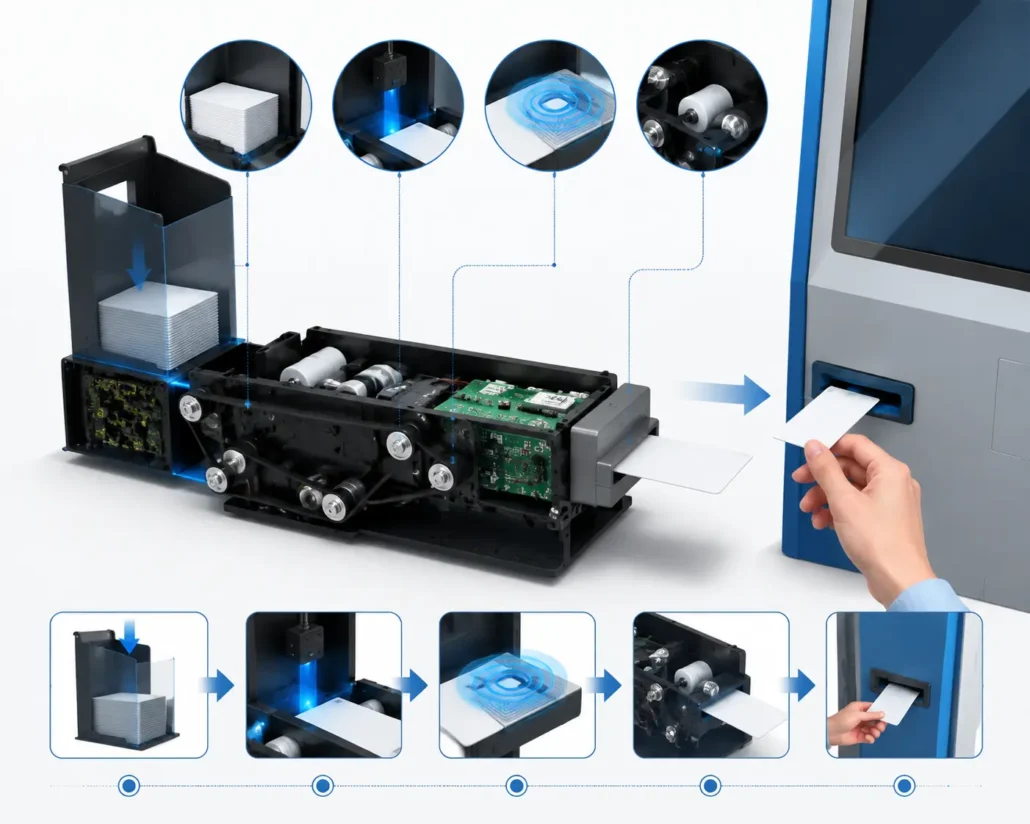
A typical RFID card dispensing workflow includes several steps:
1. Card Storage
Cards are loaded into the hopper or storage area before operation.
The capacity depends on:
- Card thickness
- Hopper design
- Expected transaction volume
- Maintenance frequency
2. Card Detection And Separation
When the system receives a dispensing command, the mechanism detects the card position and separates one card from the stack.
Reliable separation is critical because multiple cards being issued together can interrupt the user workflow.
3. RFID Verification Or Encoding (Optional)
Some applications require additional RFID processing before the card is delivered.
The workflow may include:
- Reading existing card information
- Writing new card data
- Verifying card status
This is common in:
- Hotel key card systems
- Access control applications
- Personalized membership programs
4. Card Dispensing
After processing is completed, the card is delivered to the user through the kiosk output area.
The dispensing process needs to consider:
- User interaction
- Output position
- Card collection behavior
- System confirmation
5. Transaction Confirmation
The kiosk software confirms:
- Card issued successfully
- Error status
- Remaining card availability
- Transaction completion
RFID Card Dispenser Applications For Self-Service Systems
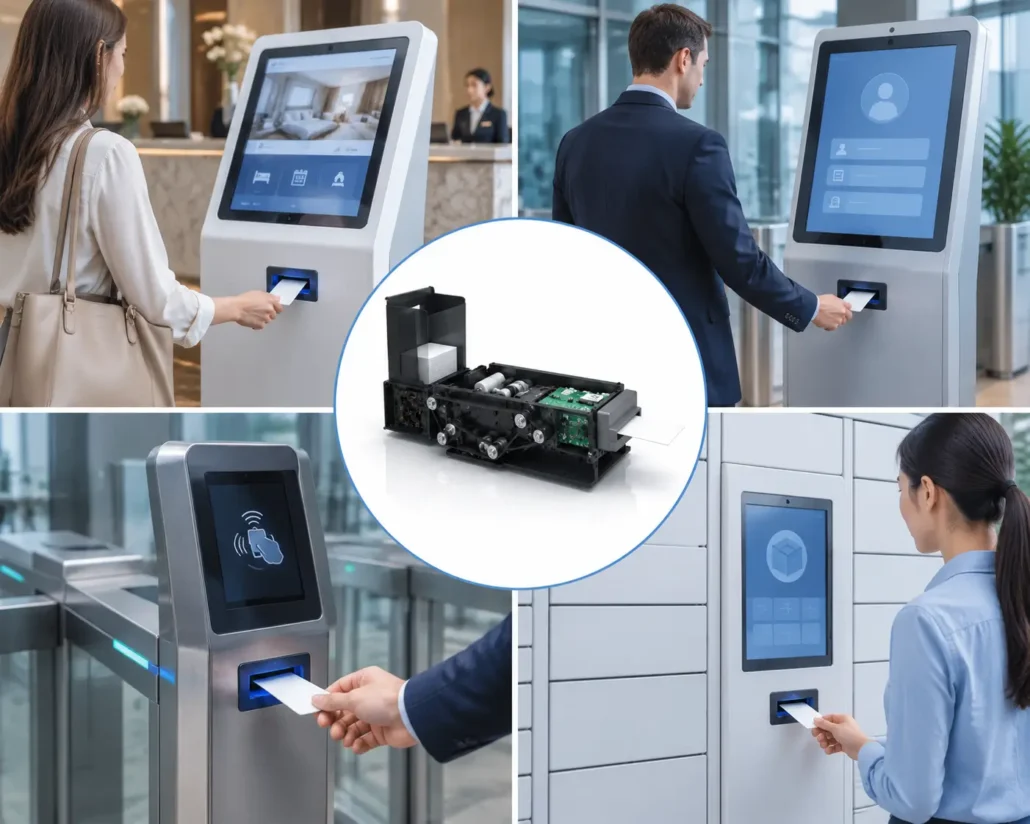
RFID card dispensers are used in many self-service applications where users need to receive RFID credentials automatically.
Although membership and loyalty systems were early applications, modern deployments now include hospitality, access control, visitor management, smart lockers and other unattended terminals.
Different applications have different requirements for:
- Card type
- Card capacity
- Dispensing workflow
- RFID processing method
- Software integration
- Maintenance planning
For system integrators, the correct RFID card dispenser should be selected based on the complete application workflow rather than only the hardware specification.
Hotel Self Check-In Kiosks
Hotel self check-in kiosks are one of the most important applications for RFID card dispensers.
For hotel key card management system, the RFID card dispenser is usually integrated with hotel PMS systems, RFID encoding modules and room key card management workflows.
After guest verification, reservation confirmation and payment completion, the kiosk can automatically issue room key cards without front desk assistance.
A hotel RFID card issuing system typically requires:
- Reliable RFID card dispensing
- Compatibility with hotel key cards
- Integration with PMS or hotel management systems
- Compact kiosk installation
- Stable unattended operation
- Easy maintenance
In many hotel deployments, the card dispenser is not only responsible for issuing cards.
It may also need to support:
- RFID card encoding
- Card verification
- Card collection
- Card reuse workflow
For 24/7 self-service hotel environments, system reliability and maintenance accessibility are usually more important than initial hardware cost.
Related Resource:
Hotel Self Check-In Hardware Solutions
Access Control Card Issuing Systems
RFID card dispensers are widely used in automated access control terminals.
These systems allow users to receive temporary or permanent access credentials without manual card distribution.
Typical applications include:
- Employee access cards
- Visitor access cards
- Temporary credentials
- Facility management systems
- Building access terminals
Access control projects usually focus on:
- RFID compatibility
- Secure card issuing workflow
- Integration with access control software
- Reliable operation in unattended environments
For these systems, the dispenser must work correctly with the complete access workflow, including user verification, authorization and credential delivery.
Related Resource:
Access Control Kiosk Hardware Solutions
Visitor Management Kiosks
Visitor management systems often require automated card issuing after visitor registration.
An RFID card dispenser allows visitors to receive temporary access cards after completing self-registration.
Typical requirements include:
- Fast card issuing
- Simple user operation
- Integration with visitor management software
- Optional card collection and reuse
- Reliable operation during busy periods
Compared with traditional reception-based visitor management, automated card issuing reduces staff workload and improves visitor flow.
For organizations handling many daily visitors, a reliable RFID card dispenser can become an important part of the complete visitor management workflow.
Related Resource:
Visitor Management Hardware Solutions
Smart Locker Systems
Smart locker systems can use RFID cards as temporary access credentials.
An integrated RFID card dispenser allows users to receive locker access cards automatically after completing registration, payment or authentication.
Typical applications include:
- Parcel lockers
- Workplace lockers
- Fitness center lockers
- Rental storage systems
- Shared facility lockers
Smart locker projects usually require:
- Reliable card issuing
- Compact integration
- Stable communication with locker software
- Low maintenance requirements
For reusable card applications, a recycling RFID card dispenser may provide additional operational advantages by supporting card return and reuse.
Related Resource:
Smart Locker Hardware Solutions
Membership And Loyalty Kiosks
Membership and loyalty programs remain one of the traditional applications for RFID card dispensers.
Businesses can issue:
- Membership cards
- Loyalty cards
- Customer credentials
- Service access cards
through automated self-service terminals.
Typical requirements include:
- RFID card compatibility
- Customized issuing workflow
- Integration with membership software
- Stable operation during high-volume usage
Compared with manual card distribution, automated RFID card dispensing improves efficiency and provides a more consistent customer experience.
Related Resource:
Membership and Loyalty Kiosks Hardware Solution
Parking Access And Ticketing Systems
RFID card dispensers can also be integrated into parking and access ticketing systems where users need to receive RFID credentials automatically.
Typical applications include:
- Parking access cards
- Temporary parking credentials
- Visitor parking systems
- Automated entry terminals
Parking applications usually require:
- Reliable dispensing performance
- Fast transaction processing
- Easy maintenance
- Compatibility with existing access control systems
For high-volume parking environments, the card dispenser should be evaluated together with transaction speed, environmental conditions and service accessibility.
Related Resource:
Parking & Ticket Hardware Solutions
Key Features To Evaluate When Selecting An RFID Card Dispenser
When selecting an RFID card dispenser for a self-service project, system integrators should look beyond basic card issuing capability.
A dispenser that works well in laboratory testing may still face challenges after deployment if card compatibility, mechanical design, communication method and maintenance requirements are not considered early.
The following factors are commonly evaluated before selecting an RFID card dispensing solution.
RFID Card Compatibility
RFID compatibility is the first factor to confirm before selecting a card dispenser.
Different projects may use different RFID technologies, including:
- 13.56MHz RFID cards
- MIFARE cards
- NFC-compatible cards
- Customized RFID credentials
The dispenser should be evaluated together with:
- Card specification
- RFID reader or encoder module
- Software workflow
- Final application requirements
For example:
Hotel key card systems may require RFID card encoding before issuing, while visitor management systems may only require reliable card dispensing.
Card Thickness And Material Considerations
Card thickness variation is one of the most common factors affecting dispensing reliability.
Although many cards follow standard dimensions, real projects may include differences caused by:
- Card material
- Embedded chips
- Printing layers
- Protective coating
- Customized card structures
A reliable RFID card dispenser should always be tested with the actual cards planned for deployment.
System integrators should avoid selecting a dispenser only based on standard card specifications.
Real card samples provide more accurate validation results.
Related Resource:
Why Card Thickness Variations Cause Card Dispensing Problems
Hopper Capacity And Maintenance Frequency
Hopper capacity directly affects maintenance requirements in unattended systems.
A larger card storage capacity can reduce:
- Operator visits
- Card loading frequency
- Service interruptions
However, higher capacity is not always the only objective.
The correct capacity depends on:
- Daily transaction volume
- Kiosk location
- Maintenance schedule
- Operator workflow
For example:
A hotel self check-in kiosk operating continuously may require different capacity planning compared with a small membership registration terminal.
Single Hopper Or Multi Hopper Card Dispenser?
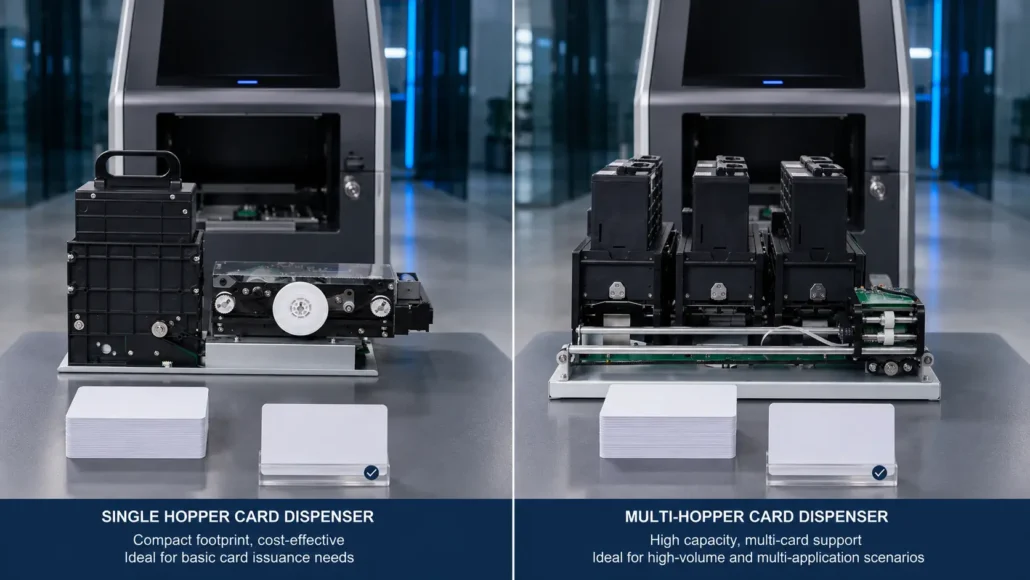
The hopper design should match the card issuing workflow.
Single Hopper Card Dispenser
A single hopper solution is suitable when:
- Only one card type is required
- The issuing process is simple
- Cost efficiency is important
Typical applications:
- Membership cards
- Visitor cards
- Simple access cards
Multi Hopper Card Dispenser
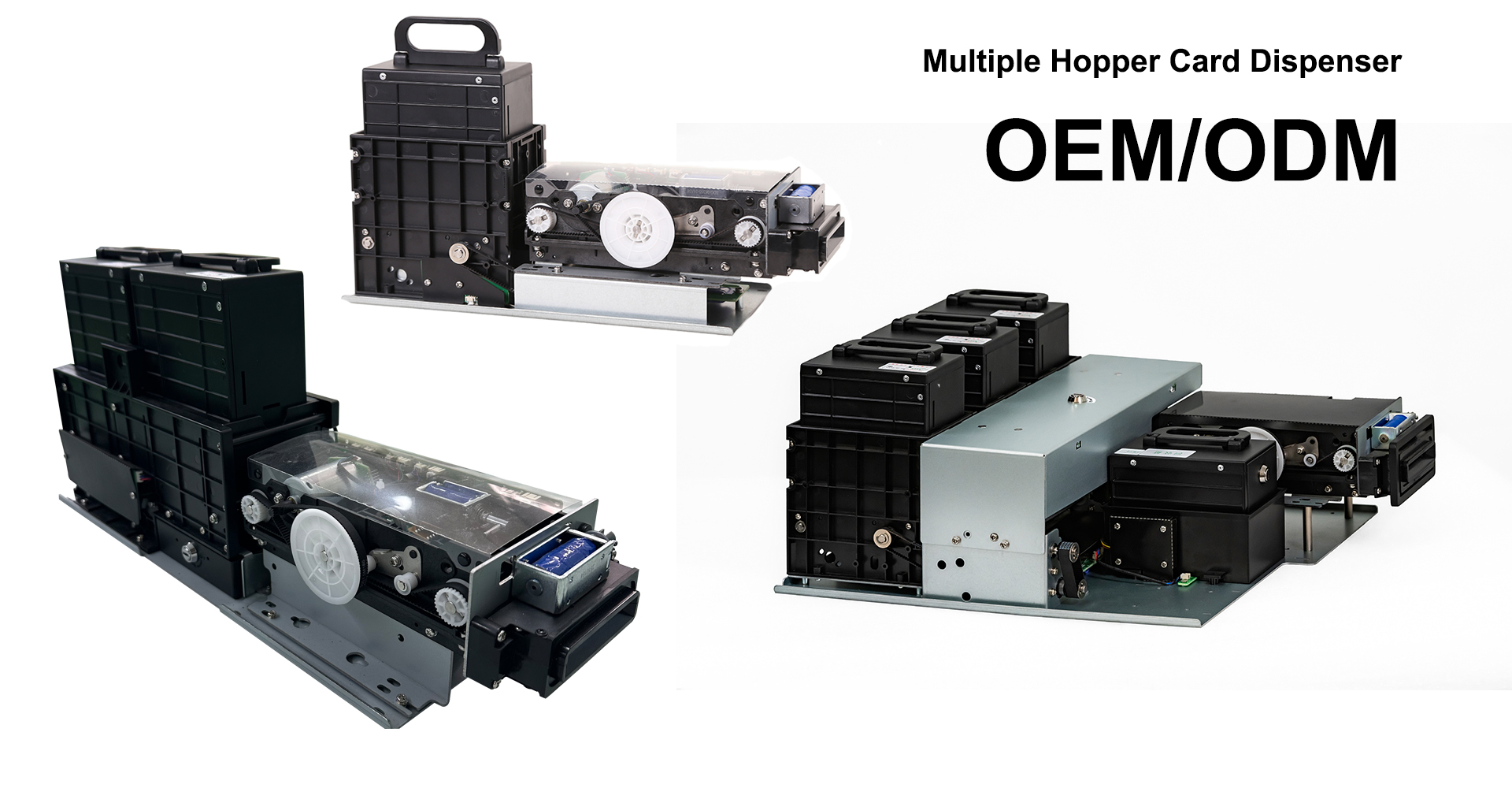
A multi hopper card dispenser allows systems to manage multiple card types.
Typical applications include:
- Different access levels
- Multiple membership categories
- Hotel card types
- Customized credential programs
For complex self-service systems, multi hopper designs can reduce manual card replacement and improve operational flexibility.
RFID Encoding And Card Personalization Capability
Some RFID card issuing systems require more than dispensing.
The card may need to be encoded or personalized before being provided to the user.
A complete RFID issuing workflow may include:
- Card selection
- RFID encoding
- Data verification
- Card dispensing
- User collection
This is common in applications such as:
- Hotel room key cards
- Access control credentials
- Membership cards
- Visitor authorization cards
System integrators should confirm whether the project requires:
- Integrated RFID reader/writer
- External RFID module
- Software control interface
- Encoding verification process
RFID Card Dispenser Integration Guide: SDK, API And Hardware Considerations
For system integrators, integrating an RFID card dispenser into a self-service kiosk involves more than connecting a hardware device.
The dispenser needs to communicate with:
- kiosk software
- embedded controller
- RFID modules
- database systems
- user interface workflow
A successful deployment requires hardware, software and mechanical teams to evaluate the complete system before prototype production.
The most common integration problems usually do not come from the card dispenser itself.
They appear when:
- communication methods are unclear
- SDK resources are insufficient
- status feedback is ignored
- kiosk structure is finalized too early
- maintenance requirements are not considered
Communication Interface Requirements
Different RFID card dispenser models may support different communication methods depending on project requirements.
Common interfaces include:
- USB communication
- RS232 serial communication
- Customized communication interfaces
The correct interface should match:
- kiosk controller hardware
- operating system environment
- software architecture
- deployment requirements
Windows-Based Kiosk Integration
Windows remains a common platform for commercial self-service terminals.
Typical integration methods include:
- USB connection
- Serial communication
- SDK libraries
- Demo applications
System developers normally evaluate:
- driver availability
- SDK documentation
- command structure
- sample code
- status feedback functions
Linux And Embedded System Integration
Linux-based kiosks and embedded terminals often require more flexible hardware communication methods.
Before deployment, engineering teams should confirm:
- communication protocol
- command definitions
- Linux compatibility
- development resources
For large-scale deployments, early software validation can significantly reduce integration risk.
SDK And API Integration Requirements
A professional RFID card dispenser solution should provide sufficient development resources for system integration.
Important resources include:
- SDK documentation
- communication protocol
- command instructions
- sample code
- testing tools
- error status definitions
During software development, engineers may need to control functions such as:
- card dispensing
- card collection
- card availability detection
- hopper status
- error handling
- transaction confirmation
A complete SDK reduces development time and helps the kiosk software handle real-world operating conditions.
Before starting kiosk software development, engineers should review communication protocols, SDK resources and testing procedures to reduce integration risk.
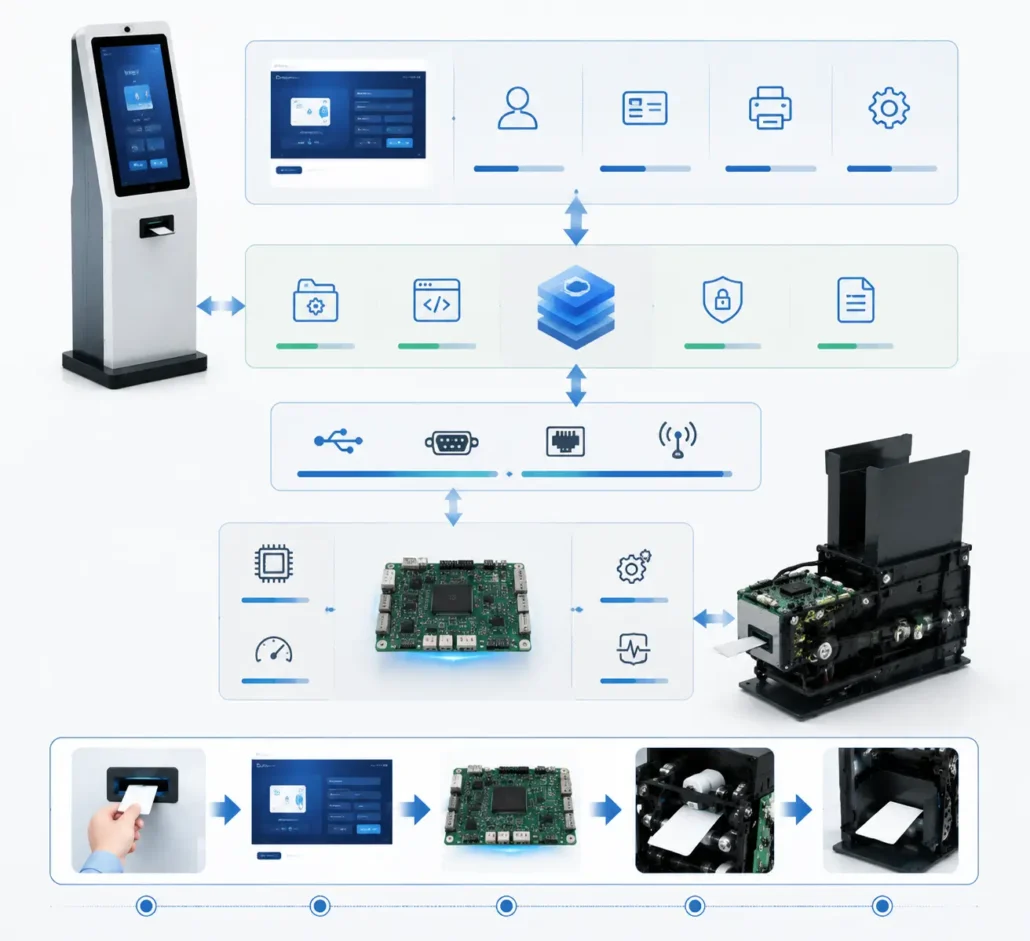
RFID Card Issuing Workflow Integration
A typical RFID card issuing workflow includes several system layers.
Step 1: User Authentication
The user completes:
- identity verification
- reservation confirmation
- payment process
- registration
Step 2: System Authorization
The kiosk software determines whether a card should be issued.
Examples:
- hotel room assignment
- visitor approval
- membership activation
- locker access authorization
Step 3: RFID Card Processing
Depending on the application:
The system may:
- read card information
- write new RFID data
- verify card status
Step 4: Card Dispensing
The dispenser receives the command and delivers the card.
The system confirms:
- successful output
- card availability
- error conditions
Step 5: Transaction Completion
The software records:
- issued card information
- transaction status
- user confirmation
Card Collection And RFID Card Recycling
Not all projects only require card issuing.
Some applications need card return and reuse.
This creates a different workflow:
User Returns Card

↓

Card Detection

↓

Card Collection

↓

Card Verification

↓

Card Storage

↓

Future Reuse
Typical applications include:
- hotel reusable room cards
- temporary visitor cards
- employee access cards
- rental credential systems
Compared with one-way dispensing, recycling solutions can reduce:
- card consumption
- operational cost
- manual card management
For projects requiring repeated card usage, an RFID card recycler should be evaluated instead of a standard dispenser.
Deployment Reliability Considerations
Many RFID card dispenser problems only appear after months of operation.
Successful deployments usually evaluate several practical factors before mass production.
Card Storage Conditions
Environmental conditions can affect:
- card friction
- card stacking
- dispensing consistency
Teams should consider:
- storage temperature
- humidity
- dust exposure
- card quality consistency
Maintenance Accessibility
A self-service kiosk may operate thousands of transactions without operator attention.
Therefore, maintenance access is important.
Engineering teams should evaluate:
- card loading method
- hopper replacement
- internal access
- service procedure
A dispenser that performs well but is difficult to maintain may increase long-term operating costs.
Transaction Volume
Expected usage volume affects:
- hopper capacity
- mechanical design
- maintenance frequency
- recycling requirements
Low-volume applications may prioritize:
- compact size
- cost efficiency
High-volume applications usually prioritize:
- reliability
- larger capacity
- easier service
- stable operation
Recommended SNRO RFID Card Dispenser Solutions
The following models can be used as starting points for different project requirements.
Final selection should always be confirmed based on:
- card type
- application scenario
- kiosk structure
- software requirements
- deployment volume
SNR-K750L RFID Card Recycler
The SNR-K750L is designed for self-service applications requiring RFID card issuing, collection and recycling functions.
Compared with traditional dispensing solutions, the recycling workflow allows organizations to manage reusable RFID cards more efficiently.
Typical applications include:
- hotel self check-in kiosks
- visitor card reuse systems
- access control terminals
- membership card programs
- smart locker solutions
Key evaluation points include:
- RFID card compatibility
- dispensing reliability
- collection capability
- recycling workflow
- kiosk integration flexibility
- unattended operation stability
The SNR-K750L is suitable for projects where cards are expected to return into the system and be reused.
SNR-K750C RFID Card Dispenser
The SNR-K750C is designed for applications requiring reliable RFID card issuing without a recycling workflow.
It provides a practical solution for automated card distribution.
Typical applications include:
- membership card kiosks
- visitor management terminals
- access control systems
- credential issuing terminals
The SNR-K750C is suitable when the workflow is:
Card Storage

↓

Card Issuing

↓

User Receives Card
It is a practical option for projects requiring straightforward integration and reliable automated card dispensing.
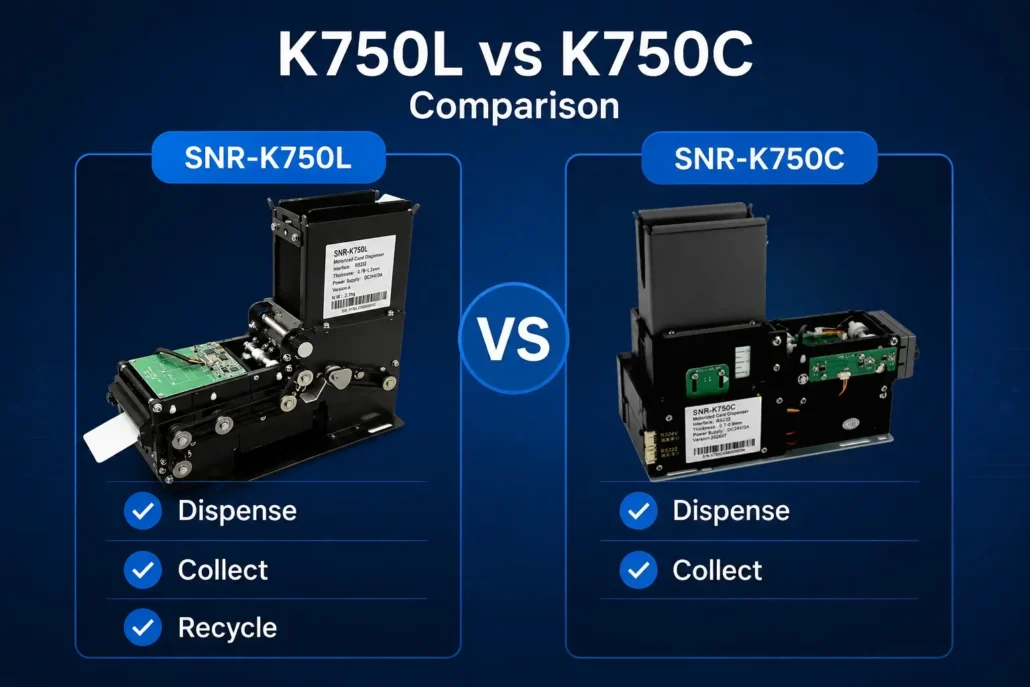
SNR-K750L vs SNR-K750C Selection Guide
| Requirement | Recommended Solution |
|---|---|
| Simple card issuing | SNR-K750C |
| Hotel reusable room cards | SNR-K750L |
| Card collection required | SNR-K750L |
| Visitor card reuse | SNR-K750L |
| Membership card issuing | SNR-K750C |
| Basic credential distribution | SNR-K750C |
| Complete card lifecycle management | SNR-K750L |
| High-value reusable RFID cards | SNR-K750L |
Need Multiple Card Types?
For projects requiring different card categories, a multi-hopper card dispenser can provide additional flexibility.
Typical scenarios:
- different membership levels
- multiple access permissions
- hotel card categories
- customized credential programs
The correct hopper configuration depends on:
- card types
- daily volume
- software workflow
- operational requirements
Common RFID Card Dispenser Problems In Real Deployments
Many RFID card dispenser projects work well during prototype testing but encounter unexpected issues after large-scale deployment.
The reason is that real environments introduce additional factors:
- different card batches
- continuous operation
- user behavior
- maintenance limitations
- environmental changes
- software integration complexity
Understanding these challenges before deployment can help system integrators reduce field problems.
Card Dispensing Failure Caused By Card Thickness Variation
One of the most common issues in card dispensing systems is inconsistent card thickness.
Although RFID cards usually follow standard dimensions, real cards may vary because of:
- different manufacturers
- printing layers
- embedded chips
- protective coating
- customized materials
These small differences can affect:
- card separation
- feeding accuracy
- dispensing consistency
Before mass production, integrators should always test the dispenser with the actual production cards.
A laboratory test using a different card sample may not represent real deployment conditions.
Double Card Dispensing Issues
Double card dispensing happens when more than one card is moved during a single dispensing operation.
Possible causes include:
- card surface friction differences
- card thickness variation
- unsuitable card storage conditions
- incorrect mechanical adjustment
- worn components
To reduce this risk, projects should evaluate:
- actual card samples
- expected transaction volume
- dispenser adjustment capability
- maintenance procedure
Why RFID Card Dispensers Become Less Reliable Over Time
A dispenser may work perfectly during initial testing but become less predictable after months of operation.
Common factors include:
- dust accumulation
- environmental changes
- card quality differences
- frequent transactions
- delayed maintenance
This is why experienced integrators evaluate not only initial performance but also:
- long-term stability
- service accessibility
- spare part availability
- maintenance workflow
RFID Card Dispenser Maintenance Considerations
Preventive maintenance is often overlooked during the early project stage.
However, unattended systems require planned maintenance.
Important maintenance factors include:
Card Loading Procedure
Operators should be able to reload cards quickly without removing unnecessary components.
Internal Cleaning
Long-term operation may require cleaning of:
- card path
- rollers
- sensors
- mechanical contact areas
Error Recovery
The system should allow operators to understand:
- card empty status
- dispensing errors
- communication errors
- mechanical issues
How To Select The Right RFID Card Dispenser For Your Project
Before selecting an RFID card dispenser, system integrators should confirm the following points.
1. What RFID Card Type Will Be Used?
Confirm:
- RFID frequency
- card technology
- card thickness
- card manufacturer
2. Is Encoding Required?
Determine whether the project needs:
- simple card issuing
or:
- RFID writing
- card personalization
- card verification
3. Is Card Recycling Required?
Choose between:
Standard Card Dispenser
Suitable for:
- one-way issuing workflow
Examples:
- membership cards
- visitor cards
- access cards
RFID Card Recycler
Suitable for:
- reusable card workflow
Examples:
- hotel room cards
- temporary access cards
- rental credentials
4. What Is The Expected Transaction Volume?
Evaluate:
- daily card usage
- maintenance frequency
- kiosk operating hours
High-volume projects may require:
- larger capacity
- stronger mechanical design
- recycling capability
5. How Will The Dispenser Be Integrated?
Confirm:
- communication interface
- SDK availability
- operating system
- software development requirements
Frequently Asked Questions (FAQ)
What is an RFID card dispenser?
An RFID card dispenser is an automated hardware device that stores and issues RFID cards in self-service systems.
It is commonly integrated into hotel self check-in kiosks, access control terminals, visitor management systems, smart lockers and membership platforms.
Unlike a simple card feeder, an industrial RFID card dispenser is designed to work with kiosk software, controllers and RFID modules as part of a complete card issuing workflow.
Can an RFID card dispenser encode RFID cards?
Yes, some RFID card dispensing systems can support card encoding when integrated with RFID reader/writer modules.
The complete workflow may include:
- card selection
- RFID encoding
- data verification
- card dispensing
This function is commonly required in applications such as hotel key cards, access control credentials and personalized membership cards.
What RFID cards can be used with an RFID card dispenser?
The supported card type depends on the dispenser model and integrated RFID module.
Common RFID technologies include:
- 13.56MHz RFID cards
- MIFARE cards
- NFC-compatible cards
Before deployment, system integrators should verify:
- card specification
- thickness
- RFID technology
- complete workflow requirements
How many cards can an RFID card dispenser hold?
Card capacity depends on:
- dispenser design
- hopper configuration
- card thickness
- application requirements
Different projects may require different capacities based on:
- daily transaction volume
- maintenance frequency
- kiosk location
What is the difference between an RFID card dispenser and a card recycler?
An RFID card dispenser mainly focuses on storing and issuing cards.
An RFID card recycler adds card collection and reuse capability.
A standard dispenser is suitable for one-way issuing workflows.
A recycling solution is better for applications requiring card return and reuse, such as:
- hotel self check-in kiosks
- temporary access systems
- reusable credentials
Can RFID card dispensers be integrated into kiosks?
Yes.
RFID card dispensers are commonly integrated into self-service kiosks through communication interfaces such as:
- USB
- RS232
System integrators should confirm:
- SDK availability
- communication protocol
- operating system compatibility
- status feedback functions
- mechanical integration requirements
What should I consider when selecting an RFID card dispenser?
Important factors include:
- RFID card compatibility
- card thickness
- hopper capacity
- dispensing speed
- single or multi hopper design
- card collection requirements
- SDK and interface support
- deployment environment
The correct selection should be based on the complete kiosk workflow rather than only hardware specifications.
Recommended SNRO RFID Card Dispenser Solutions
SNRO provides RFID card dispensing solutions designed for integration into:
- hotel self check-in kiosks
- access control terminals
- visitor management systems
- smart lockers
- membership kiosks
SNR-K750C RFID Card Dispenser
Recommended for:
- automated card issuing
- membership programs
- visitor cards
- access credentials
Suitable when the workflow requires:
Card Storage

↓

Card Dispensing

↓

User Collection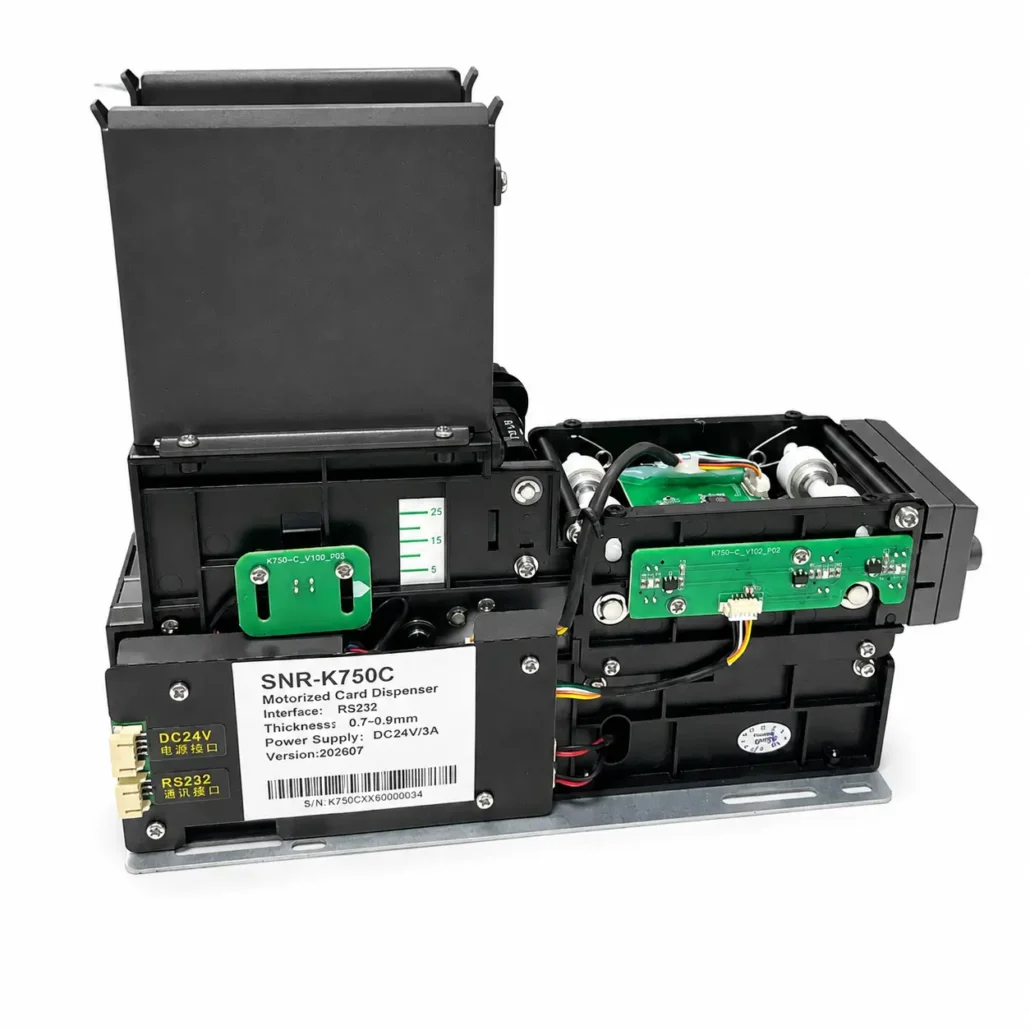
SNR-K750L RFID Card Recycler
Recommended for:
- reusable RFID card applications
- hotel key card recycling
- visitor card return systems
- credential reuse workflows
Suitable when the workflow requires:
Card Issuing

↓

User Usage

↓

Card Collection

↓

Card Recycling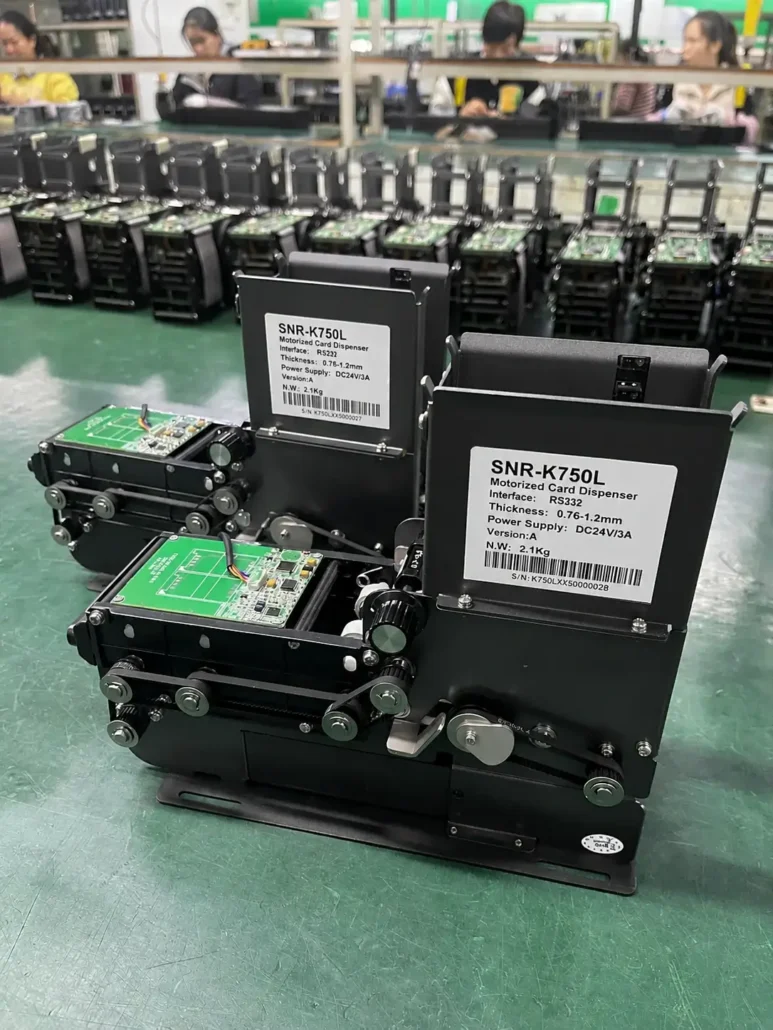
Need Help Selecting An RFID Card Dispenser?
Choosing the right RFID card dispenser depends on your complete system design.
Send us:
- RFID card specification
- card thickness
- kiosk drawing
- operating system
- interface requirement
- expected deployment quantity
- application scenario
SNRO can help evaluate a practical RFID card dispensing solution for prototype testing and production deployment.
Related Resources
RFID Card Dispenser Knowledge
- Card Dispenser Hub: Industrial Knowledge Center for Automated Card Issuing Systems
- Card Dispenser SDK and Integration Guide
- Card Dispenser Preventive Maintenance Guide
- Why Card Dispensers Fail in Real Self-Service Systems
- RFID Card Dispenser vs Magnetic Card Dispenser
Application Solutions
- Hotel Self Check-In Hardware Solutions
- Visitor Management Hardware Solutions
- Smart Locker Hardware Solutions
- Access Control Kiosk Hardware Solutions
- Membership Card Issuing Solutions
Product References
Conclusion
An RFID card dispenser is not simply a card feeding device.
In modern self-service systems, it is a critical hardware component connecting digital workflows with physical credential delivery.
The best solution is not always the cheapest dispenser.
It is the solution that matches:
- card requirements
- application workflow
- software integration
- maintenance plan
- long-term deployment environment
For system integrators building hotel kiosks, access control terminals, visitor systems, smart lockers or automated credential platforms, selecting the right RFID card dispenser early can significantly reduce integration risk and improve deployment reliability.