

Blog
RFID Card Dispenser vs Magnetic Card Dispenser: Which Is Better for Self-Service Kiosks?

Introduction
When planning a self-service kiosk project, one of the earliest decisions is choosing the card technology that will be used throughout the system.
For many years, magnetic stripe cards were widely used in hotels, transportation systems, membership programs and access control applications. Today, however, RFID technology has become the preferred choice for many new deployments.
Despite this trend, some projects still consider magnetic cards due to legacy system compatibility, existing infrastructure or cost concerns.
Selecting the wrong card technology at the beginning of a project can lead to:
- Additional development costs
- Hardware replacement
- Software redesign
- Integration challenges
- Future upgrade limitations
This guide compares RFID card dispensers and magnetic card dispensers from a system integrator’s perspective and explains which technology is better suited for modern self-service kiosk deployments.
What Is an RFID Card Dispenser?
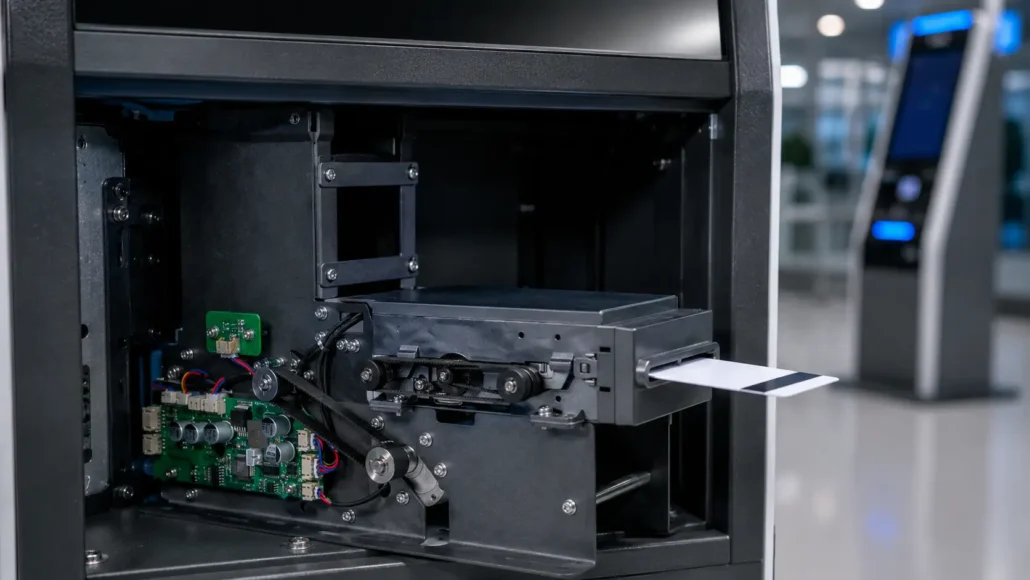
An RFID card dispenser is a motorized card issuing device designed to store, encode and dispense RFID cards automatically.
RFID cards communicate through radio frequency technology and do not require physical contact with the reader.
Common RFID technologies include:
- MIFARE Classic
- MIFARE DESFire
- ISO14443
- ISO15693
- NTAG
- NFC-compatible cards
RFID card dispensers are commonly used in:
Hotel Self Check-In Kiosks
Automatically issuing room cards after guest registration.
Visitor Management Systems
Providing temporary access credentials for visitors and contractors.
Smart Locker Systems
Issuing locker access cards and user credentials.
Access Control Systems
Supporting employee and visitor authentication.
Membership Card Issuance Kiosks
Automatically creating customer membership cards.
 What Is a Magnetic Card Dispenser?
 What Is a Magnetic Card Dispenser?
A magnetic card dispenser is designed to issue cards that store information on a magnetic stripe.
The stripe contains data encoded on one or more tracks.
Typical magnetic card technologies include:
- Track 1
- Track 2
- Track 3
Magnetic cards have historically been used in:
- Legacy hotel systems
- Transportation ticketing
- Membership programs
- Banking applications
- Access control systems
Although magnetic cards remain in use, their adoption in new kiosk deployments has decreased significantly in recent years.
Why RFID Has Become the Dominant Technology
Over the past decade, RFID technology has become the preferred choice for most new self-service deployments.
Several factors have contributed to this transition.
Contactless Operation
RFID cards do not require direct physical contact with readers.
This reduces wear and improves user experience.
Improved Security
Modern RFID technologies provide:
- Encryption
- Authentication
- Secure key management
- Anti-cloning protection
Longer Card Life
Magnetic stripes can become damaged over time.
RFID cards generally offer better durability under frequent use.
Mobile Integration
Many RFID systems can be integrated with:
- Mobile credentials
- NFC-enabled smartphones
- Digital identity systems
Future Scalability
RFID platforms are often easier to expand and integrate with future technologies.
For these reasons, most new hotel, visitor management and smart building projects now favor RFID-based solutions.
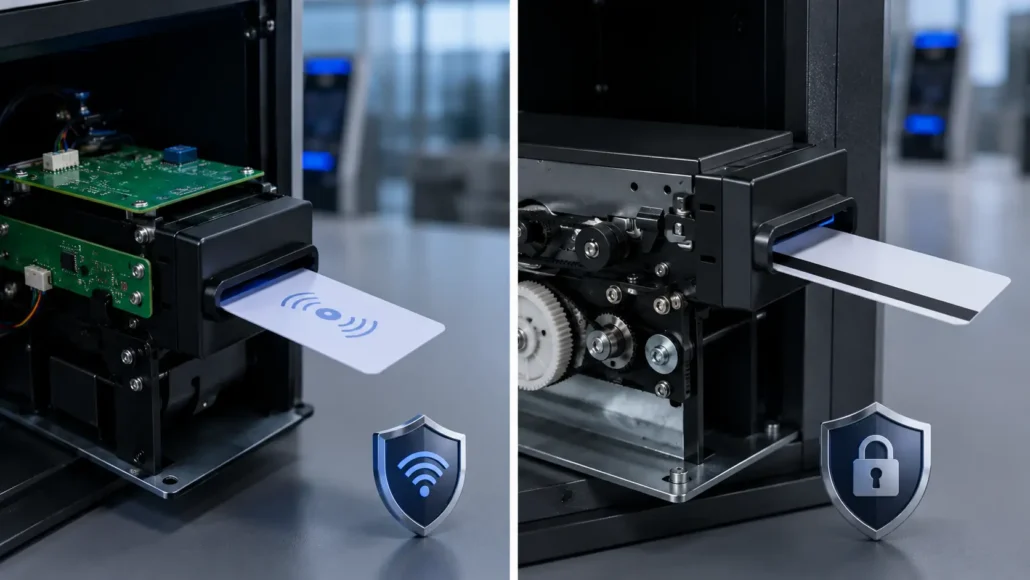
RFID vs Magnetic Card Comparison
| Evaluation Factor | RFID Card | Magnetic Card |
|---|---|---|
| Security | High | Low |
| Durability | High | Medium |
| Contactless Operation | Yes | No |
| Encryption Support | Yes | Limited |
| Mobile Integration | Yes | No |
| Maintenance Requirements | Lower | Higher |
| User Experience | Better | Basic |
| Future Scalability | High | Low |
| Environmental Resistance | Better | Moderate |
| Long-Term Viability | Strong | Declining |
For most new deployments, RFID provides greater flexibility and long-term value.
What Experienced Integrators Usually Evaluate
Before selecting a card technology, experienced system integrators typically evaluate:
Security Requirements
Does the project require encrypted credentials?
Existing Infrastructure
Must the new system support legacy card technologies?
Lifecycle Expectations
How long is the system expected to remain in service?
Door Lock Compatibility
For hotel projects, lock system compatibility is often critical.
SDK Availability
Are development resources available?
Maintenance Requirements
How often will hardware be serviced?
Card Replacement Costs
What are the long-term consumable costs?
Future Upgrade Potential
Can the system evolve with future technologies?
These considerations frequently influence technology selection more than card cost alone.
Why Hotels Have Largely Moved to RFID
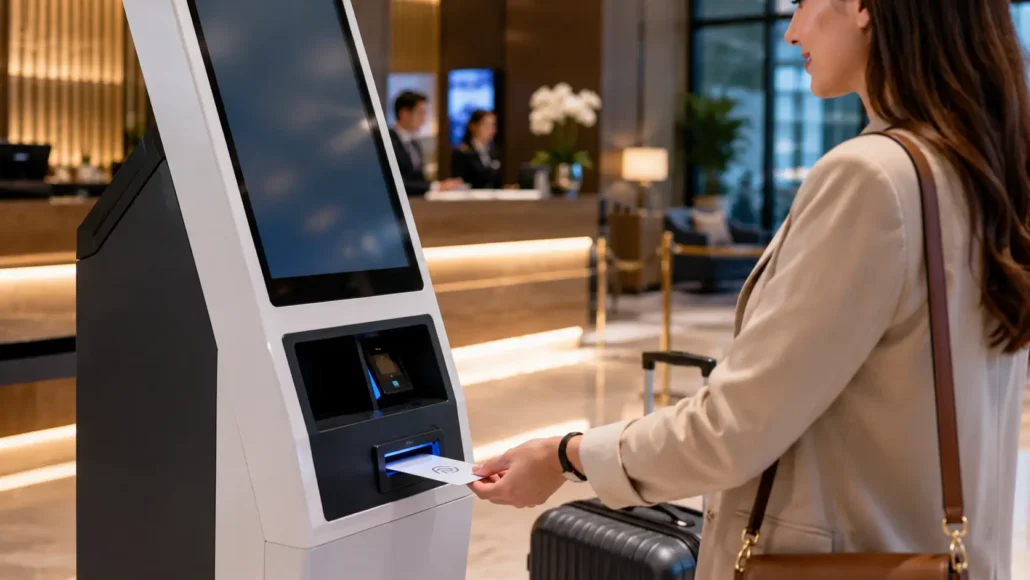
Hotel self check-in kiosks represent one of the strongest examples of RFID adoption.
Today, most new hotel projects prefer RFID because:
- Better guest experience
- Faster card issuance
- Improved security
- Easier room access management
- Compatibility with modern lock systems
- Better integration with hospitality software
Many hotel lock manufacturers now primarily support RFID-based solutions.
As a result, RFID card dispensers have become the preferred choice for hotel self-service kiosks.
Visitor Management Applications
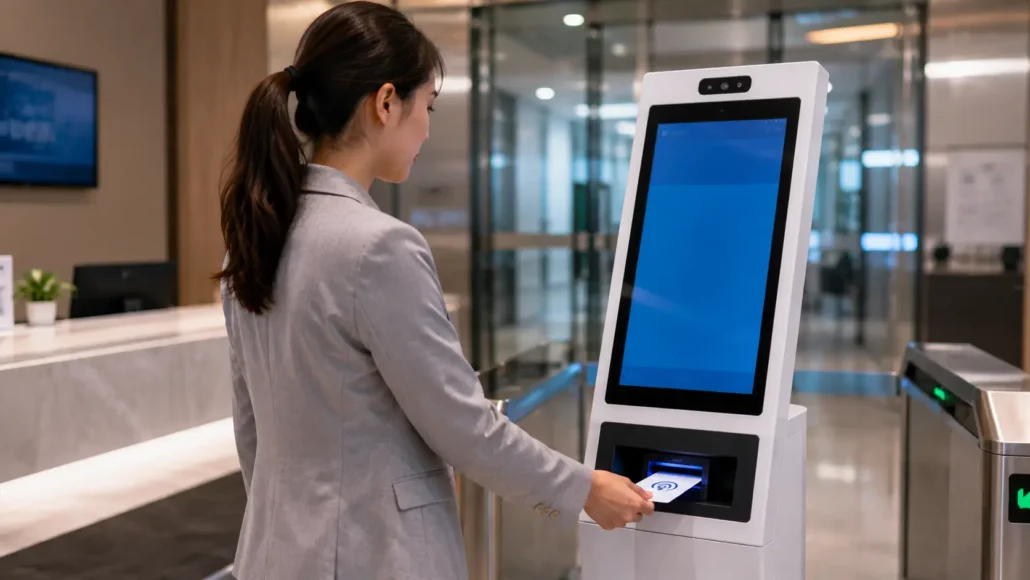
Visitor management systems increasingly rely on RFID credentials.
Compared with magnetic cards, RFID offers:
- Faster check-in workflows
- Better access control integration
- Improved credential security
- Easier credential management
- Better visitor tracking capabilities
These advantages make RFID particularly attractive for:
- Corporate offices
- Government facilities
- Industrial sites
- Healthcare environments
- Educational campuses
Deployment Reality: What Changes After Installation
Laboratory testing rarely reflects actual deployment conditions.
After installation, projects may encounter:
Card Wear
Magnetic stripes can degrade after repeated use.
Dust and Contamination
Environmental conditions may affect card reading performance.
Humidity
Moisture can influence card durability and storage conditions.
High Usage Frequency
Heavy usage often exposes weaknesses in older card technologies.
Long-Term Maintenance
Magnetic card systems may require more maintenance over time.
RFID technology generally performs better under these conditions, which is one reason it has become the preferred choice for unattended kiosk deployments.
Common Questions Integrators Ask
Can magnetic cards still be used today?
Yes. Many legacy systems continue to operate successfully using magnetic cards.
Is RFID more expensive?
RFID cards may have a higher initial cost, but often provide lower long-term operational costs.
Can RFID cards be encoded inside kiosks?
Yes. Many RFID card dispensers support integrated encoding before dispensing.
Which technology is better for hotels?
For most modern hotel projects, RFID is generally the preferred choice.
Which technology is better for visitor management?
RFID typically offers stronger security and easier access control integration.
Can RFID and magnetic cards coexist?
Yes. Some projects support both technologies during migration periods.
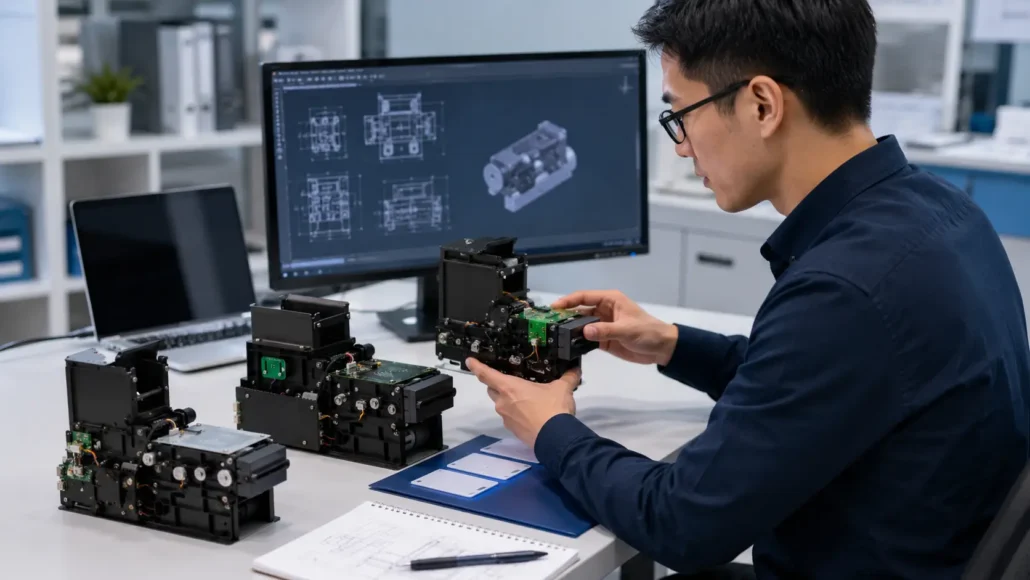
Recommended RFID Card Dispenser Solutions
SNR-K750-L
Recommended for:
- Hotel self check-in kiosks
- RFID room card issuance
- Hospitality automation systems
Advantages:
- RFID card support
- Stable dispensing
- Hotel-focused deployment
SNR-CD212-M8
Recommended for:
- Visitor management systems
- Access control projects
- Smart building deployments
Advantages:
- Reliable card separation
- RFID compatibility
- Compact integration
SNR-K720
Recommended for:
- Membership card issuance
- General card dispensing projects
- Self-service kiosks
Advantages:
- Cost-effective solution
- Flexible integration
- Proven reliability
Conclusion
While magnetic card technology still exists in some legacy environments, RFID has become the dominant technology for most new self-service kiosk deployments.
For hotel self check-in kiosks, visitor management systems, smart lockers and access control applications, RFID provides:
- Better security
- Longer service life
- Improved user experience
- Easier system integration
- Stronger future scalability
Experienced system integrators therefore evaluate RFID compatibility early in the project lifecycle to ensure the selected hardware can support both current operational requirements and future system expansion.
Related Resources
- How to Choose a Motorized Card Dispenser for Self-Service Kiosks
- How to Choose a Card Dispenser for Hotel Self Check-In Kiosks
- Hotel Self Check-In Hardware Solutions
- Visitor Management Hardware Solutions
- Smart Locker Hardware Solutions
- Common RFID Card Dispensing Challenges in Self-Service Kiosks
- Why Card Hopper Design Matters More Than Most Teams Realize
FAQ
What is an RFID card dispenser?
An RFID card dispenser is a device that automatically stores, encodes and dispenses RFID cards in self-service systems.
What is a magnetic card dispenser?
A magnetic card dispenser issues cards that store data on a magnetic stripe.
Is RFID more secure than magnetic cards?
Yes. RFID technologies generally offer stronger security and encryption capabilities.
Are magnetic cards becoming obsolete?
Many legacy systems still use magnetic cards, but most new deployments are moving toward RFID technology.
Can RFID cards be encoded automatically?
Yes. Many RFID card dispensers support automatic card encoding before dispensing.
Which technology is better for hotel self check-in kiosks?
RFID is generally preferred because of its security, reliability and compatibility with modern hotel lock systems.
Which technology is better for visitor management systems?
RFID typically provides better credential security and access control integration.
Do RFID card dispensers require SDK support?
Most integration projects benefit from SDK resources, protocol documentation and engineering support.
What industries commonly use RFID card dispensers?
Hospitality, visitor management, healthcare, government services, smart lockers and access control systems.
Which SNRO model is recommended for RFID hotel card issuance?
SNR-K750-L is commonly used for hotel RFID card issuance and self check-in kiosk integration.