


Telecom SIM Card Dispensing Hardware Solutions
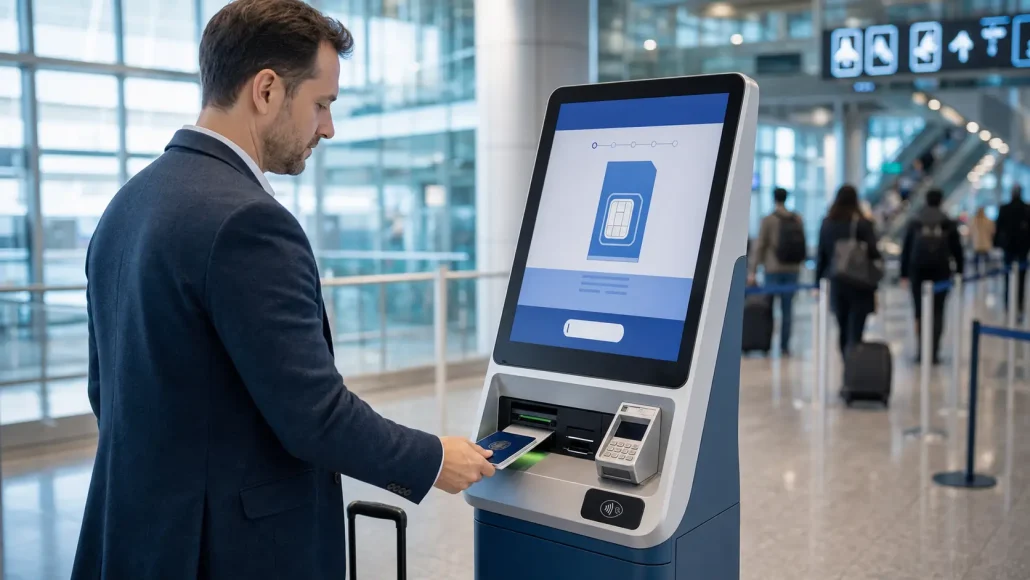
Reliable Hardware for Automated SIM Card Issuance
A SIM card dispensing system is not simply a card issuing machine. It is a complete telecom self-service automation system that integrates SIM card dispensing, customer identification, payment processing, receipt printing, backend activation, and system monitoring into one coordinated workflow.
A reliable telecom SIM card kiosk requires multiple hardware modules working together, including a motorized SIM card dispenser, touchscreen interface, ID verification device, barcode or QR scanner, kiosk printer, industrial mini PC, and telecom backend platform.
For system integrators and telecom operators, the real challenge is not SIM card distribution. The challenge is ensuring stable interaction between hardware, software, telecom activation systems, and real-world user behavior under unattended conditions.
Quick Answer
A SIM card dispensing system typically includes:
- Touchscreen kiosk for customer interaction
- SIM card dispenser for automated card issuance
- ID verification module for KYC compliance
- QR / barcode scanner for activation or voucher reading
- Kiosk thermal printer for receipts or activation codes
- Payment terminal for prepaid SIM transactions
- Industrial mini PC for system control
- Telecom backend platform for SIM activation
System reliability depends on integration stability across all hardware modules rather than individual device performance.
What Is a SIM Card Dispensing System?
A SIM card dispensing system is a telecom self-service kiosk solution designed to automatically issue physical SIM cards while managing identity verification, payment processing, activation workflows, and receipt generation.
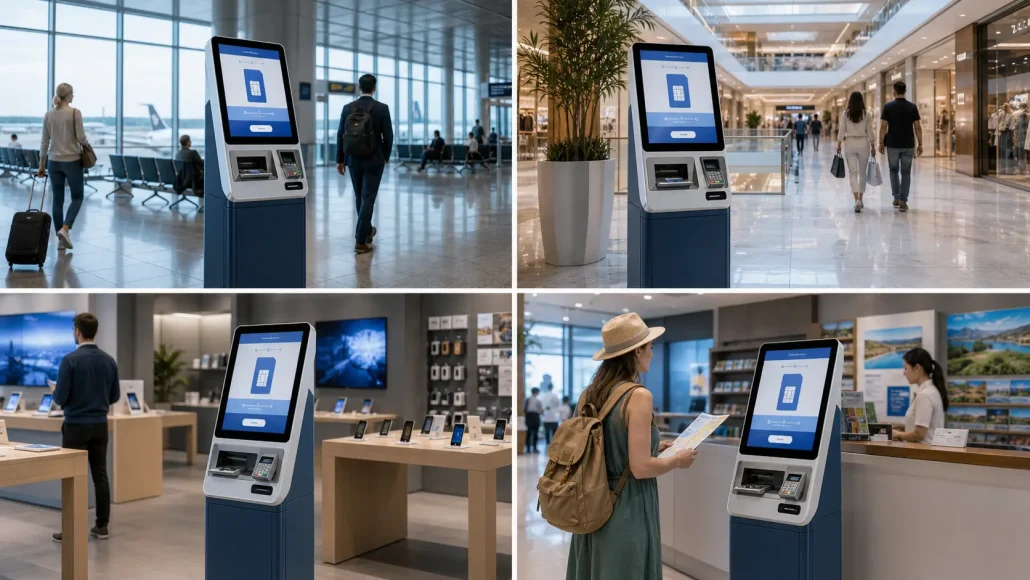
It is widely used in airport kiosks, telecom branches, retail stores, transportation hubs, and public service areas.
These systems allow customers to purchase, collect, replace, or activate SIM cards with minimal staff involvement, improving operational efficiency for telecom operators.
Where This Solution Fits?
This hardware solution is suitable for telecom and self-service projects where physical SIM card issuance, card replacement, printed confirmation, or automated customer service is required.
Typical project owners may include:
- Telecom operators
- MVNO service providers
- Airport SIM card service companies
- Kiosk manufacturers
- System integrators
- Retail telecom service providers
- Transportation hub service operators
- OEM self-service terminal builders
The solution can be configured for attended retail environments, semi-attended telecom branches, or unattended self-service deployments depending on local regulations, operator workflow, and project requirements.
Typical Telecom SIM Card Kiosk Applications
SNRO hardware can support telecom self-service applications such as:
- Airport tourist SIM card vending kiosks
- Telecom operator self-service terminals
- SIM card replacement machines
- Prepaid SIM card issuing kiosks
- MVNO self-service activation terminals
- Retail store self-service SIM card stations
- Campus or transportation hub SIM issuing terminals
- Customer service kiosks for telecom branches
- Public service communication terminals
- Unattended SIM distribution systems
The exact hardware configuration depends on whether the project issues physical SIM cards, printed activation vouchers, eSIM QR code receipts, or a combination of card dispensing and printed documents.
Some telecom SIM card kiosk projects share similar hardware logic with credential issuing and visitor verification systems, especially when identity verification, barcode scanning and controlled card issuance are required.
For related credential-based kiosk applications, see our Access Control Kiosk Hardware Solutions and Visitor Management Hardware Solutions.
What Does a Typical SIM Card Kiosk Include?
A complete SIM card dispensing kiosk includes:
- Touchscreen interface for user interaction
- SIM card dispenser for automated issuance
- ID verification device for KYC workflows
- QR / barcode scanner for voucher or activation code reading
- Kiosk thermal printer for receipts and activation confirmations
- Payment terminal for prepaid services
- Industrial mini PC for system coordination
- Telecom backend system for activation and account provisioning
All components must operate as a unified system rather than independent devices.
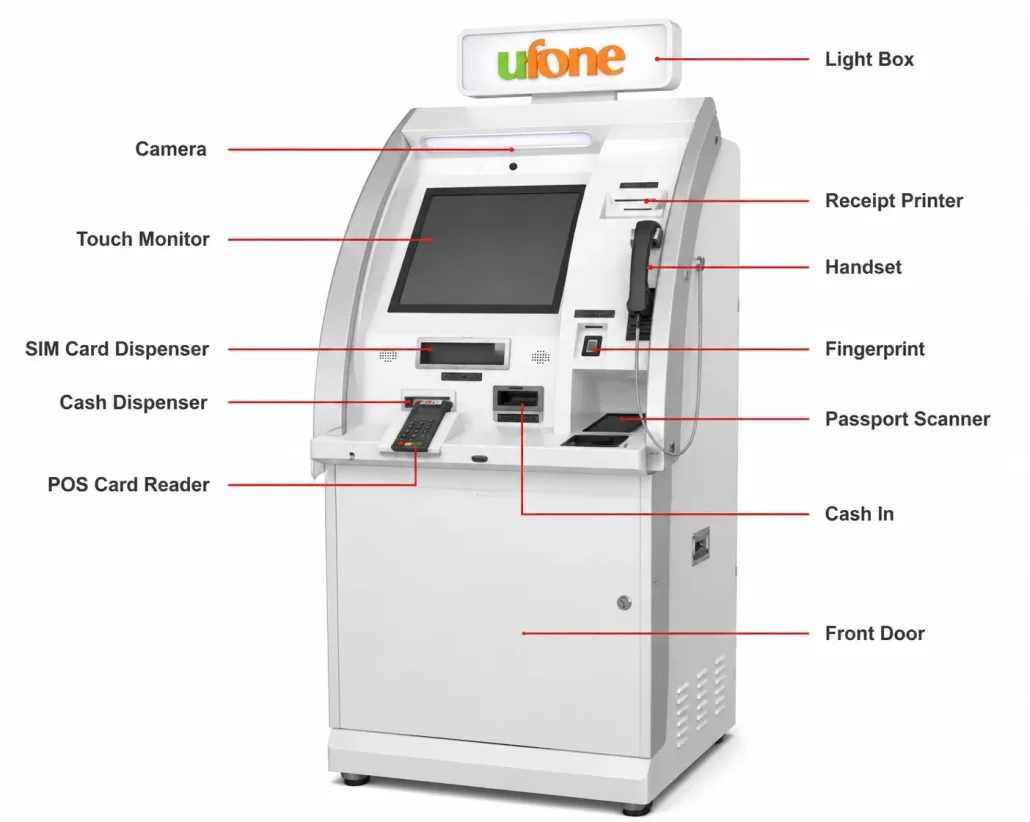
System Architecture Overview
Touchscreen → ID Verification → Payment Module → SIM Card Dispenser → Printer → Industrial Controller → Telecom Activation Platform
System failures usually occur at workflow transitions such as verification, dispensing, activation, or communication delays between modules.
A telecom SIM card kiosk is part of a broader self-service kiosk hardware system architecture. SIM card dispensers, ID verification devices, payment modules, kiosk printers, barcode scanners, industrial controllers and telecom backend platforms must work together reliably during unattended activation workflows.
For a complete overview of how different kiosk hardware modules are planned, connected and maintained in unattended terminal systems, visit our Self-Service Kiosk Hardware System Hub.
Recommended Hardware Architecture for Telecom SIM Card Kiosks
| Hardware Module | Function | Integration Consideration |
|---|---|---|
| Touchscreen | User interface | UI stability, durability, kiosk environment design |
| SIM Card Dispenser | Automated SIM issuance | Card thickness, feeding reliability, anti-double-feed design |
| ID Verification Device | KYC compliance | OCR accuracy, API integration, document support |
| QR / Barcode Scanner | Activation & voucher reading | Scan precision, mounting angle, interface type |
| Kiosk Printer | Receipt & activation output | Paper capacity, cutter reliability, SDK support |
| Payment Terminal | Prepaid SIM transactions | Certification, security compliance |
| Industrial Mini PC | System control layer | OS compatibility, 24/7 stability, interface support |
| Telecom Backend Platform | SIM activation system | API stability, real-time activation reliability |
SIM Card Dispenser Selection Considerations
The SIM card dispenser is the core module of the system.
Key factors include:
- SIM card size and format
- Card thickness and material consistency
- Card carrier design
- Hopper capacity
- Single-card dispensing accuracy
- Double-card prevention mechanism
- Card empty detection
- Position feedback system
- Interface type (USB / RS232 / LAN)
- SDK or protocol support
- Maintenance access design
- Field replacement efficiency
Many failures in real deployment are caused not by the dispenser itself, but by card packaging variation, humidity, dust, static electricity, or incorrect loading procedures.
In telecom SIM card kiosks, the card dispenser is not an isolated issuing device. It must support real SIM card carrier conditions, stable single-card separation, accurate position feedback, SDK or protocol communication and field maintenance access.
For a broader overview of motorized card dispensing modules, card compatibility, hopper design, SDK integration and self-service kiosk deployment considerations, visit our Card Dispenser Hub.
Kiosk Printer Selection Considerations
Kiosk printers are required for:
- SIM activation receipts
- Payment confirmations
- QR code printing for eSIM activation
- Transaction records
- Customer service vouchers
Key selection factors:
- Paper width (58mm / 80mm)
- Paper roll capacity
- Cutter reliability
- Presenter function (if required)
- Print quality for QR codes
- Driver and SDK support
- OS compatibility (Windows / Linux / Android)
- Maintenance accessibility
Receipt and activation-code printing can become a critical part of telecom self-service workflows, especially when the kiosk prints payment confirmations, SIM activation receipts or QR codes for eSIM activation. Printer reliability, QR print quality, cutter stability, driver support and maintenance access should be reviewed before prototype testing.
For more information about embedded printer modules, Linux driver support, SDK integration and printer selection for self-service terminals, visit our Kiosk Printer Hub.
Industrial Mini PC Requirements
The industrial controller manages communication between all hardware modules.
Key requirements:
- Stable Windows or Linux support
- Multiple USB / COM interfaces
- LAN connectivity
- Fanless operation for reliability
- Long-term availability
- 24/7 continuous operation
- Remote maintenance capability
- Sufficient computing performance
Typical Hardware Selection Matrix
| Scenario | Hardware Focus |
|---|---|
| Airport SIM vending kiosk | High capacity dispenser, payment module, printer, scanner |
| Telecom branch kiosk | ID verification, dispenser, printer, backend integration |
| SIM replacement machine | Reliable dispensing + activation workflow |
| Prepaid SIM vending system | Payment + dispensing + voucher printing |
| eSIM activation kiosk | QR printing + scanner + backend system |
| High-traffic deployment | Durability, maintenance access, monitoring |
| Compact kiosk | Space-efficient dispenser and printer design |

Common Hardware Challenges in SIM Card Dispensing Systems
Many telecom kiosk projects perform well during prototype testing, but real deployment conditions are different.
Common challenges include:
- SIM card thickness variation
- Double-card dispensing
- Card jam due to humidity or dust
- Backend activation delay
- Payment workflow interruption
- Incorrect device status feedback
- Printer paper replacement difficulty
- Limited maintenance access
- High-traffic peak load failure
For this reason, experienced telecom solution providers evaluate hardware reliability, device feedback, and maintenance access early in the project lifecycle.
System Integration Requirements
A SIM card dispensing system usually requires coordination between hardware modules and the telecom operator’s software platform.
System integrators should evaluate:
- Card dispenser communication protocol
- Printer driver or SDK
- Scanner interface
- Industrial PC operating system
- Device status monitoring
- Error feedback and recovery logic
- Telecom backend activation workflow
- Payment system integration if required
- Identity verification workflow
- Remote monitoring and maintenance
- Field support process
The SIM card dispenser should not be treated as an isolated component. It should be tested together with the full customer workflow, including user selection, identity verification, payment, card issuing, receipt printing, activation confirmation, and exception handling.
Why Maintenance Access Matters
In telecom self-service deployments, field maintenance cost can become more important than the initial hardware cost.
A kiosk design should allow technicians to:
- Reload SIM cards easily
- Clear card jams safely
- Replace printer paper quickly
- Access the dispenser without removing unrelated modules
- Check cables and connectors
- Replace the dispenser or printer if needed
- Run test commands or utility tools
- Verify device status after service
If maintenance access is ignored during kiosk design, even a reliable dispenser or printer may create high service costs in real deployment.
Recommended SNRO Hardware for Telecom SIM Card Kiosks
SNR-K750S Barcode SIM Card Dispenser for Telecom Self-Service Kiosks
Recommended for SIM card vending machines, SIM replacement kiosks, prepaid SIM issuing terminals, MVNO activation systems and airport SIM card service kiosks.
SNR-K750S is suitable for telecom self-service projects where SIM cards need to be identified, issued and tracked through barcode-based workflows. It is designed for automated SIM card issuance, unattended operation and integration with telecom activation platforms.
SNR-CD300 USIM / IC Card Issuing Module for SIM Card Activation Kiosks
Recommended for USIM card issuing terminals, telecom SIM activation kiosks, IC card issuing systems and compact self-service card issuing applications.
SNR-CD300 is suitable for telecom projects that require a compact card issuing module for USIM / IC card workflows, SIM activation machines or operator service terminals.
SNR-CD100 Card Dispenser with Magnetic / IC / RF Reader Writer for Multi-Card Telecom Kiosks
Recommended for self-service terminals that require automatic card dispensing together with magnetic, IC or RF card read/write capability.
SNR-CD100 is suitable for multi-card telecom service kiosks, customer service terminals, membership card issuing systems and self-service card issuing machines that require card personalization, data writing or compatibility with different card technologies.
Related Products
For telecom SIM card dispensing systems, the following SNRO product categories may be useful:
- Motorized card dispensers for SIM card issuance kiosks
- Fixed mount barcode scanners for SIM activation and voucher reading
- Kiosk thermal printers for SIM activation receipts
- Industrial mini PCs for telecom self-service kiosk control
- Android POS terminals for telecom retail service workflows
- POS thermal receipt printers for telecom service counters
Related Resources
For project planning and hardware evaluation, these resources may be helpful:
- Card dispenser integration knowledge hub
- Card dispenser SDK and protocol integration guide for telecom kiosks
- Motorized card dispenser selection guide for SIM card kiosks
- Double-card dispensing issues in SIM card dispenser systems
- Why SIM card dispensers fail in real telecom kiosk deployments
- Common card dispensing challenges in telecom self-service kiosks
- Kiosk printer SDK guide for SIM activation receipt printing
- Linux kiosk printer integration guide for telecom self-service kiosks
- Drivers, SDKs and technical downloads for kiosk hardware integration
- RFID card dispenser vs magnetic card dispenser for self-service card issuing
Related Solutions
- Access control kiosk hardware for credential issuing workflows
- Visitor management hardware for identity verification and credential issuing
- Self-checkout hardware systems for payment and receipt workflows
Related Technical Downloads
The following technical resources may support SIM card dispenser, kiosk printer, scanner and industrial controller integration during telecom self-service kiosk development:
- SDK packages for SIM card dispenser integration
- communication protocol documents for card dispenser control
- Linux and Windows drivers for kiosk printer modules
- SDK resources for activation receipt printing
- mechanical drawings and CAD files for kiosk installation
FAQ
What is a SIM card dispensing system?
A SIM card dispensing system is a self-service kiosk solution that automatically issues SIM cards while managing identity verification, payment, printing, and telecom activation workflows.
Can SIM cards be issued automatically?
Yes. Motorized card dispensers allow fully automated SIM card issuance after verification and payment.
What hardware is required for a SIM kiosk?
It typically includes a SIM dispenser, touchscreen, ID verification device, scanner, printer, payment terminal, industrial controller, and telecom backend connection.
Can the system support eSIM?
Yes. eSIM workflows can be supported using QR code printing and activation systems.
What industries use SIM card kiosks?
Telecom operators, MVNOs, airports, transportation hubs, and retail telecom providers.
What causes SIM card dispenser failures in real deployments?
Most issues come from card thickness variation, humidity, dust, packaging inconsistency, or incorrect loading.
Does SNRO provide SDK support?
Yes. SNRO provides SDKs, drivers, and communication protocols for system integration.
Can the system operate unattended?
Yes. With proper hardware design, error recovery, and monitoring systems, unattended operation is possible.
How important is maintenance access?
It is critical. Poor maintenance design increases downtime and operational cost significantly.
Can SIM kiosks integrate with telecom backend systems?
Yes. Integration is done via APIs or protocol-based communication with telecom platforms.
What should be tested before mass deployment?
Real SIM samples, dispensing reliability, backend activation workflow, and full system integration under load conditions.
Need Help Planning Your Telecom SIM Card Kiosk Hardware?
If you are developing a SIM card vending machine, SIM replacement kiosk, telecom self-service terminal, airport SIM issuing kiosk, MVNO activation terminal, or operator service kiosk, SNRO can help review your hardware requirements before prototype or mass production.
Share your SIM card format, card carrier thickness, required card capacity, identity verification workflow, printer requirement, scanner requirement, operating system, interface requirements and expected transaction volume. Our team will recommend a suitable SIM card dispenser, kiosk printer, scanner and industrial controller configuration for your telecom self-service deployment.