

Blog
How to Choose a Card Dispenser for Smart Locker Systems?

Introduction
Smart locker systems have become increasingly common across parcel delivery networks, residential buildings, universities, offices, hospitals and industrial facilities.
While many smart lockers rely on mobile applications or QR codes, card-based access remains widely used in environments where security, user management and controlled credential issuance are required.
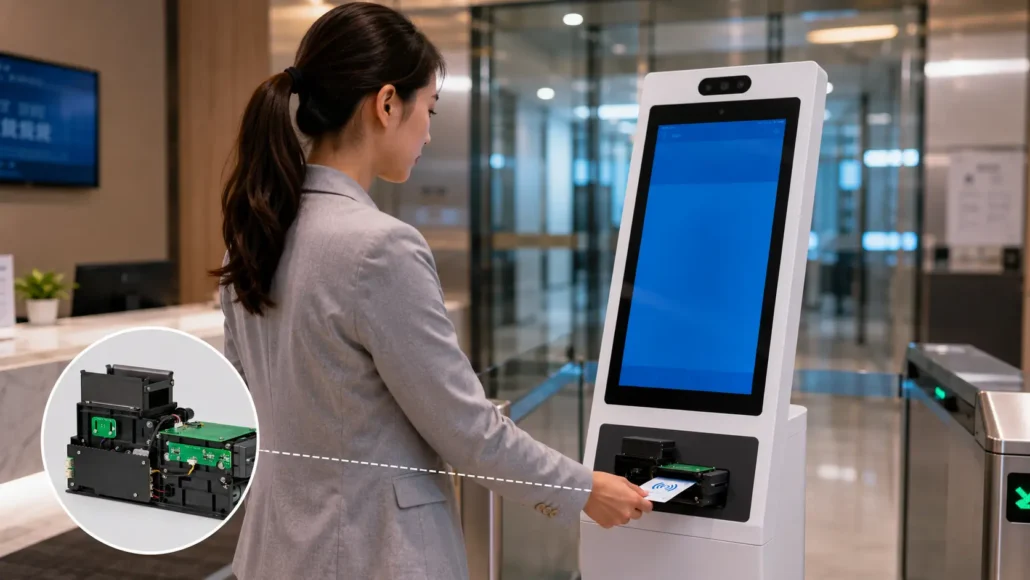
In these deployments, the card dispenser becomes an important component that connects the user, locker management platform and access control system.
Choosing the right card dispenser therefore involves much more than simply selecting a device capable of issuing cards.
Experienced system integrators typically evaluate RFID compatibility, dispensing reliability, access control integration, maintenance requirements and long-term operational stability before selecting hardware for smart locker projects.
Why Smart Locker Systems Use Card Dispensers
Card dispensers are commonly used in smart locker deployments where users need temporary or permanent credentials.
Typical applications include:
Parcel Locker Systems
Issuing temporary access cards for parcel collection and delivery management.
Corporate Smart Lockers
Providing employee access credentials for personal storage lockers.
University Locker Systems
Managing student access cards for campus storage facilities.
Healthcare Locker Applications
Issuing temporary staff and visitor credentials.
Industrial Equipment Lockers
Controlling access to tools, devices and secure equipment.
In these applications, reliable card issuance directly affects user access and operational efficiency.
What Experienced Integrators Usually Evaluate First
When selecting a smart locker card dispenser, experienced teams often focus on:
- RFID compatibility
- Card dispensing reliability
- Double-card prevention
- Card separation accuracy
- Access control integration
- SDK availability
- Linux support
- Hopper architecture
- Maintenance accessibility
- Long-term deployment stability
These factors often have a greater impact on project success than hopper capacity alone.
Why Reliability Matters More Than Dispensing Speed
Unlike retail transactions, smart locker systems are typically not high-speed environments.
Users generally care more about receiving the correct credential than receiving it a few seconds faster.
Common operational issues include:
- No card issued
- Double-card dispensing
- Card jams
- Credential activation failure
- RFID encoding errors
- Card retrieval failures
A reliable dispenser helps reduce service calls and improves user confidence in the locker system.
For most smart locker deployments, dispensing reliability is significantly more important than dispensing speed.
RFID Compatibility Should Be Evaluated Early
Most modern smart locker systems use RFID-based credentials.
Common RFID technologies include:
- MIFARE Classic
- MIFARE DESFire
- ISO14443
- ISO15693
- NFC-compatible cards
Before selecting a dispenser, integrators should verify:
- RFID reader compatibility
- Card encoding requirements
- Security requirements
- Credential lifecycle management
- SDK support
Because access credentials often control physical security, RFID compatibility should be evaluated at the beginning of the project.
 Single Hopper vs Multi-Hopper for Smart Locker Applications
 Single Hopper vs Multi-Hopper for Smart Locker Applications
Single Hopper Card Dispensers
Advantages:
- Lower cost
- Easier maintenance
- Smaller footprint
- Simpler integration
Typical applications:
- Parcel lockers
- Apartment locker systems
- Campus locker deployments
Multi-Hopper Card Dispensers
Advantages:
- Multiple credential types
- Employee and visitor card separation
- Temporary and permanent credential management
- Greater operational flexibility
Typical applications:
- Industrial locker systems
- Enterprise access management
- High-security environments
The appropriate architecture depends on credential workflows and operational requirements.
Access Control Integration Requirements
 Access Control Integration Requirements
Smart locker card dispensers rarely operate independently.
Most systems communicate with:
- Locker management platforms
- Access control systems
- Identity management systems
- Building management systems
- Cloud locker platforms
Common integration requirements include:
- Credential encoding
- Card activation
- Card inventory monitoring
- User authorization
- Event logging
- Device status monitoring
Selecting hardware with strong integration support can significantly reduce development complexity.
Linux Support and SDK Resources
 Linux Support and SDK Resources
Many smart locker systems operate on:
- Linux
- Android
- Windows
- ARM-based embedded platforms
Before selecting hardware, project teams should evaluate:
- SDK availability
- Communication protocols
- API documentation
- Sample code
- Driver support
- Engineering support resources
Integration support often has a larger impact on project timelines than hardware specifications.
Why Maintenance Accessibility Matters
Smart lockers are frequently deployed in unattended environments.
Examples include:
- Apartment buildings
- Shopping centers
- Universities
- Office buildings
- Logistics facilities
Maintenance teams often evaluate:
- Card refill procedures
- Jam recovery access
- Sensor accessibility
- Cleaning requirements
- Service intervals
A dispenser that is difficult to maintain may increase downtime and operational costs across large deployments.
Deployment Reality: What Changes After Installation
 Deployment Reality: What Changes After Installation
Laboratory testing rarely reflects real deployment conditions.
After installation, smart locker systems may encounter:
Heavy Daily Usage
High transaction volumes can expose weaknesses not visible during testing.
Environmental Conditions
Dust, humidity and temperature fluctuations may affect long-term reliability.
Card Quality Variations
Different card suppliers may introduce dimensional or RFID performance differences.
Maintenance Delays
Large locker networks often experience extended maintenance intervals.
Security Requirement Changes
Credential policies may evolve after deployment.
Experienced integrators evaluate hardware performance under these conditions before selecting a final solution.
Common Questions System Integrators Ask
Do smart locker systems require RFID cards?
Most modern locker deployments use RFID credentials because they integrate easily with access control systems.
Can cards be encoded before dispensing?
Yes. Many smart locker projects require credential encoding before issuance.
How many cards should the hopper hold?
The answer depends on transaction volume and maintenance schedules.
Is Linux support important?
Many locker management platforms operate on Linux-based systems, making Linux compatibility a common requirement.
How important is maintenance accessibility?
Very important, especially for large-scale unattended locker deployments.
Recommended Smart Locker Card Dispenser Solutions
SNR-CD212-M8
Recommended for:
- Smart locker systems
- Access control projects
- Temporary credential issuance
Advantages:
- Reliable card separation
- RFID support
- Compact integration
- Stable unattended operation
SNR-K750-L
Recommended for:
- High-security locker deployments
- RFID credential management
- Enterprise access systems
Advantages:
- Stable motorized dispensing
- RFID integration support
- Long-term operational reliability
SNR-K720
Recommended for:
- General smart locker projects
- Membership credential issuance
- Cost-sensitive deployments
Advantages:
- Practical deployment cost
- Flexible integration
- Reliable operation
What Successful Smart Locker Deployments Usually Have in Common
 What Successful Smart Locker Deployments Usually Have in Common
Successful deployments typically share several characteristics:
- Reliable card issuance
- Stable RFID handling
- Easy maintenance access
- Strong SDK resources
- Smooth access control integration
- Appropriate hopper architecture
- Hardware selected for actual deployment conditions
Projects that prioritize these factors often experience lower maintenance costs and higher operational uptime.
Conclusion
Choosing a card dispenser for a smart locker system involves more than selecting a device capable of issuing cards.
Successful deployments require reliable card handling, RFID compatibility, access control integration, maintenance efficiency and long-term operational stability.
Experienced integrators therefore evaluate both technical requirements and real-world deployment conditions before selecting hardware.
The most effective smart locker card dispenser is the one that continues issuing the correct credential reliably after years of unattended operation.
Related Resources
- Smart Locker Hardware Solutions
- How to Choose a Motorized Card Dispenser for Self-Service Kiosks
- How to Choose a Card Dispenser for Hotel Self Check-In Kiosks
- How to Choose a Card Dispenser for Visitor Management Systems
- RFID Card Dispenser vs Magnetic Card Dispenser
- Common RFID Card Dispensing Challenges in Self-Service Kiosks
- Why Card Hopper Design Matters More Than Most Teams Realize
- How Dust and Humidity Affect Card Dispenser Reliability in Self-Service Kiosks
FAQ
What is a smart locker card dispenser?
A smart locker card dispenser automatically issues access credentials used to unlock and manage locker access.
Do smart lockers require RFID cards?
Many modern smart locker systems use RFID cards because they integrate easily with access control platforms.
Can RFID cards be encoded before dispensing?
Yes. Many projects require credential encoding before the card is issued.
What is the best card dispenser for smart locker systems?
The best solution depends on security requirements, credential workflows and integration needs. CD212-M8 and K750-L are commonly used.
Is Linux support important for smart locker projects?
Many smart locker platforms operate on Linux-based systems, making SDK and protocol support important.
What causes card dispensing failures?
Common causes include card quality variation, dust, humidity, hopper design issues and insufficient maintenance.
Can one dispenser support multiple credential types?
Yes. Multi-hopper systems can support multiple card categories when required.
How important is hopper design?
Hopper design directly affects card separation reliability and maintenance requirements.