

Blog
SNRO OEM Card Dispenser: Custom-Built for Your Kiosk, Parking and Loyalty Applications
Introduction
In many self-service kiosk projects, the standard card dispenser is not the final answer. The real project may need a different hopper capacity, a special mounting position, custom firmware commands, a specific card reading workflow, a branded housing, or packaging that fits your own product line.
This is where an OEM card dispenser project becomes different from a normal component purchase.
Your card dispenser has to fit your kiosk structure, your software command logic, your card type, your maintenance plan, and your customer-facing brand. If one of these points is ignored, the issue may appear later as card jams, double-card issuing, software mismatch, difficult installation, or higher field service cost.
SNRO provides OEM card dispenser customization for system integrators, kiosk manufacturers, parking system providers, hotel kiosk builders, loyalty terminal manufacturers, access control solution providers, and OEM self-service hardware teams.
The goal is not only to supply a dispenser. The goal is to help your team choose the right base model, confirm the customization scope, test the sample, and prepare the hardware for pilot deployment or mass production.
Solution Summary
SNRO OEM card dispenser services are designed for projects that need customized card issuing hardware inside self-service terminals.
Typical customization areas include:
- Hopper capacity and card storage structure
- Card thickness and card material adaptation
- Mounting bracket and mechanical installation
- Card reading, writing, or encoding workflow
- Firmware command or protocol adjustment
- Interface and host software integration
- Logo, color, label, packaging, and user manual customization
- Project-specific documentation and technical support
The final configuration depends on your application, card type, interface, operating system, cabinet space, issuing workflow, and expected deployment quantity.
Why OEM Card Dispenser Customization Matters
Card dispensers are often located inside unattended or semi-attended machines. Users only notice them when something fails: a parking card does not issue, a hotel key card is not encoded, a loyalty card is stuck inside the machine, or a visitor badge is not delivered after registration.
For the operator, the dispenser is also tied to maintenance and system reliability.
A small mismatch can create real field problems:
- The dispenser does not fit the kiosk bracket.
- The card stack is too small for the traffic volume.
- Card thickness is outside the tested range.
- The host software cannot use the standard command set.
- A card is issued before the system finishes writing or verification.
- The kiosk cannot report empty-card or jam status.
- Staff need too much time to refill cards.
- The hardware color, label, or packaging does not match the customer’s brand program.
OEM customization helps reduce these risks before the project reaches batch production.
Typical Challenges in OEM Card Dispenser Projects
Mechanical Fit
Even when the dispenser function is suitable, the mechanical design may not match the kiosk cabinet.
Project teams need to confirm installation direction, card outlet position, service door access, screw hole location, card loading method, and cable routing before enclosure tooling.
Card Type Variation
Card dispensers may need to handle different card materials and formats.
Projects may involve PVC cards, RFID cards, IC cards, magnetic stripe cards, paper-based cards, prepaid cards, parking cards, membership cards, room key cards, or visitor passes.
Card thickness, surface finish, stiffness, embossing, and stack condition can all affect dispensing behavior.
Software Command Compatibility
Some host systems already have an established command structure.
If the dispenser protocol does not match the host software plan, the software team may need extra development work. OEM firmware or protocol adjustment can reduce that integration burden when the project requirements are clear.
Card Reading or Writing Workflow
Some projects only need card issuing.
Others need read-before-issue, write-before-issue, RFID verification, magnetic stripe reading, IC card writing, or card identity matching before delivery.
The dispenser should be selected and customized around the full workflow, not only the physical issuing action.
Branding and Channel Requirements
OEM customers may need logo printing, color matching, label design, white-label manuals, retail packaging, or bulk packaging for factory assembly.
These details are not cosmetic only. They affect channel presentation, installation workflow, spare parts handling, and after-sales support.
What Experienced Integrators Usually Consider
Experienced kiosk teams usually define the project requirements before choosing the base model.
Key questions include:
- What application will the card dispenser serve?
- What card size, thickness, material, and surface finish will be used?
- Is the project single-card-type or multi-card-type?
- Does the system need card reading, writing, encoding, or verification?
- How many cards should be stored in the machine?
- How often can field staff refill cards?
- What interface does the host controller require?
- Does the software need a custom command set?
- Does the kiosk need empty-card, card-present, jam, or retract status feedback?
- Does the dispenser fit the cabinet, outlet, and service door?
- Is logo, color, label, packaging, or manual customization required?
- Is the project in sample testing, pilot rollout, or mass production?
These questions help SNRO recommend a suitable base model and customization plan.
Recommended OEM Card Dispenser Architecture
An OEM card dispenser project usually includes both hardware and software layers.
| Layer | Typical Requirement | Why It Matters |
|---|---|---|
| Card media | Card size, thickness, material, chip, magnetic stripe, RFID | Confirms the correct dispenser and reading/writing direction |
| Card storage | Hopper capacity, single hopper, multi-hopper, collection bin | Affects refill frequency and card type management |
| Mechanical structure | Mounting bracket, outlet position, service access | Determines whether the dispenser fits the kiosk cabinet |
| Electrical interface | USB, RS232, TTL, Ethernet, or project-specific interface | Must match the host controller and wiring plan |
| Firmware logic | Commands, status feedback, error handling, issuing sequence | Reduces software integration and recovery risk |
| Card processing | Read, write, encode, verify, or issue-only workflow | Must match the business process |
| Branding package | Logo, color, label, user manual, box, bulk packaging | Supports OEM channel and deployment needs |
| Validation process | Sample test, pilot test, documentation, QC check | Confirms the customized dispenser before mass production |
This structure helps project teams avoid treating customization as a single logo request. In most OEM projects, mechanical, electrical, firmware, card media, and service requirements need to be reviewed together.
What Can SNRO Customize?
Hardware Customization
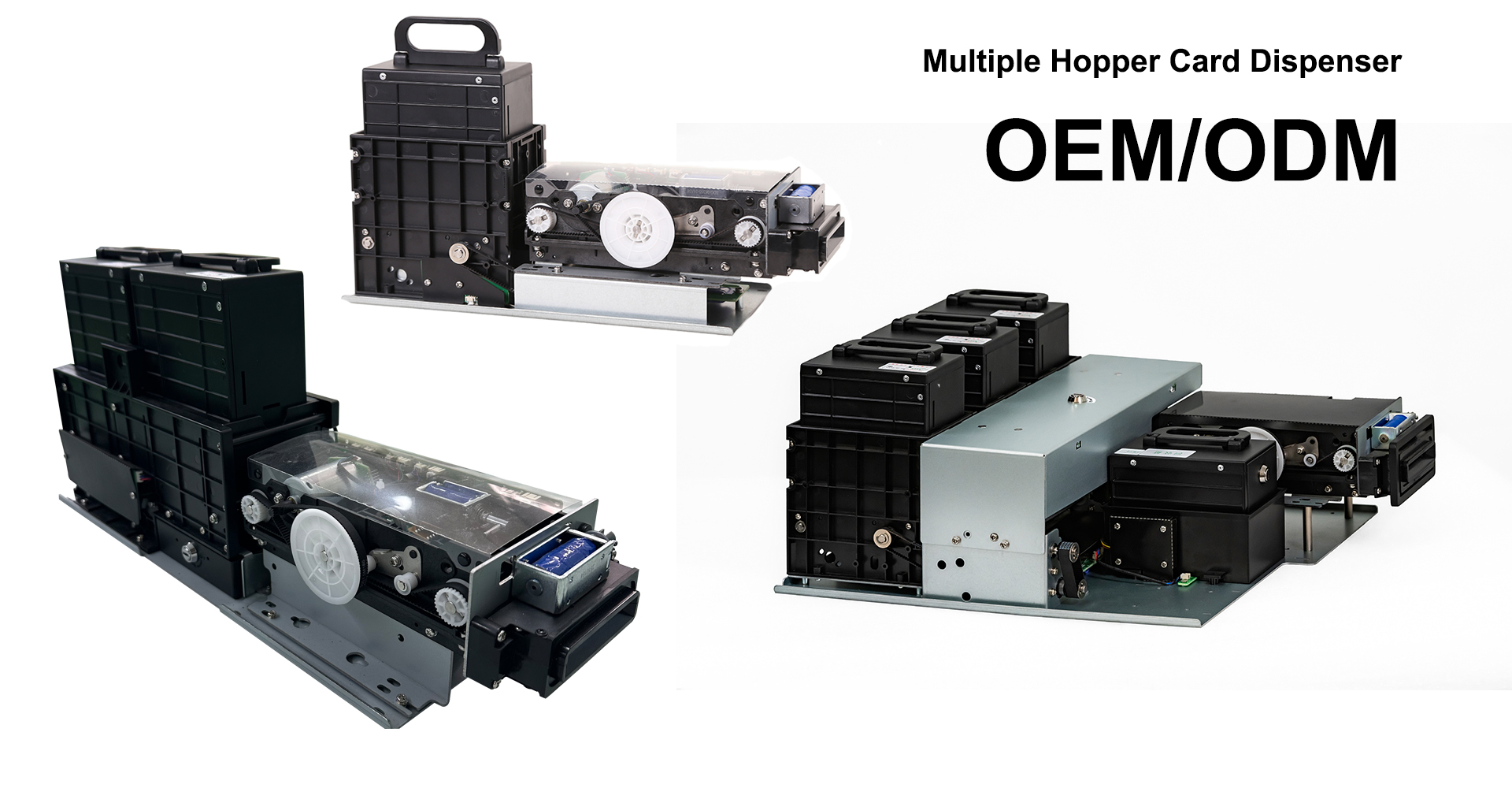
SNRO can evaluate physical customization based on your kiosk structure and card media.
Common hardware customization directions include:
- Hopper capacity adjustment
- Card storage structure evaluation
- Card thickness and card material adaptation
- Custom mounting brackets
- Card outlet alignment
- Sensor position evaluation
- Card loading and service access planning
- Housing color or visible part color matching
- Logo or label customization
For each project, the customization scope should be confirmed with real card samples, cabinet drawings, and service access requirements.
Firmware and Software Customization
Some OEM projects need the dispenser to communicate with existing software or follow a specific card issuing sequence.
Possible customization directions include:
- Protocol modification
- Command set adaptation
- Status feedback definition
- Card issuing sequence adjustment
- Read-before-issue logic
- Write-before-issue logic
- Card verification workflow
- Error reporting and diagnostic commands
- Integration support for SDK or API workflows
The goal is to reduce integration risk between the dispenser, host controller, kiosk software, and backend system.
Branding, Packaging, and Documentation
For OEM and white-label projects, SNRO can support project-specific presentation and documentation requirements.
Possible directions include:
- Logo printing or label customization
- Housing or visible part color matching
- White-label user manuals
- Quick start guides for installation teams
- Product labels and packaging support
- Retail box or industrial bulk packaging
- Project-specific technical files
Packaging and documentation should be confirmed early if the product will be resold, installed by third-party teams, or shipped to multiple markets.
OEM Card Dispenser Base Models
The following SNRO models can be used as starting points for OEM card dispenser projects. Final selection should be confirmed according to card type, card capacity, read/write requirement, interface, cabinet structure, and customization scope.
| Base Model | Typical Direction | Possible Customization Focus |
|---|---|---|
| SNR-CD212-M8 | Single-card-type issuing | Hopper capacity, interface, firmware, issuing logic |
| SNR-CD2604J-M8 | Dual-card-type issuing | Card type selection, hopper capacity, software mapping |
| SNR-CD2612-M8 | Multi-card-type issuing | Multi-card management, brand/card mapping, card stock planning |
| SNR-K720 | Parking card issuing direction | Parking workflow, ticket/card output, RFID card handling |
| SNR-K750C | Membership and loyalty card issuing | RFID encoding, read/write workflow, retract or verification logic |
| SNR-CD3000 Series | Card collection direction | Collection logic, collection bin size, card return workflow |
Field note: treat these models as starting platforms, not fixed final answers. OEM projects should be confirmed through real card testing, firmware review, mechanical review, and pilot validation.
Target Industries and Customization Scenarios
Parking and Toll Systems
Parking and toll projects may need high card volume, stable card issuing, RFID or ticket-related workflow, outdoor or semi-outdoor deployment considerations, and fast maintenance access.
Typical customization concerns include card capacity, card outlet position, card type, issuing logic, service door design, and status feedback.
Hotel Self Check-In Kiosks
Hotel kiosks may need magnetic stripe or RFID key card issuing, compact cabinet integration, front service access, and quiet guest-facing operation.
Customization may involve card encoding workflow, card outlet design, lobby kiosk structure, and branded documentation for hotel technology partners.
Retail Loyalty and Membership Kiosks
Retail loyalty systems may issue membership cards, gift cards, prepaid cards, or promotional cards.
Customization may involve card type mapping, multi-card storage, branded appearance, packaging, and software workflow for card registration or activation.
Public Transit and Smart Mobility
Transit and mobility systems may require high-volume card issuing, compatibility with specific card materials, and strong field service planning.
Project teams should confirm card stock, read/write logic, refill frequency, and remote status feedback before rollout.
Gaming and Casino Player Tracking
Gaming and casino systems may require player card issuing, loyalty registration, read/write workflow, and integration with the casino management system.
OEM planning should focus on card identity, card data workflow, system verification, and service reliability.
Healthcare Patient Management
Healthcare kiosks may issue patient ID cards, visitor cards, or service cards.
The dispenser direction should be reviewed with the hospital software workflow, card data requirement, service access, and patient-facing reliability requirements.
Access Control and Secure Facilities
Access control applications may need employee badge issuing, visitor pass issuing, RFID card writing, or secure facility card registration.
Customization should focus on card verification, read/write process, system permission workflow, and error recovery.
OEM Process: From Requirement to Mass Production
Step 1: Share Your Project Requirements
The OEM process starts with your application, card sample, kiosk structure, interface requirement, operating system, expected quantity, and customization request.
Useful information includes:
- Application scenario
- Card type and card thickness
- Read/write requirement
- Hopper capacity target
- Interface and host controller
- Kiosk cabinet drawing
- Branding or packaging requirement
- Target market and rollout plan
Step 2: Base Model Recommendation
SNRO reviews your project information and recommends a base card dispenser model or model direction.
At this stage, the goal is to define the starting platform before customization work begins.
Step 3: Customization Plan
After the base model is confirmed, SNRO reviews the required hardware, firmware, branding, packaging, and documentation adjustments.
This step may include mechanical review, firmware scope review, command or protocol discussion, and sample requirements.
Step 4: Sample and Engineering Review
For customized projects, sample testing is usually required before mass production.
Your team should test the sample with real cards, real software commands, the intended power and interface setup, and the planned cabinet structure.
Step 5: Pilot Validation
Before full rollout, pilot testing helps confirm card issuing accuracy, card reading/writing workflow, error handling, refill process, and service access.
Pilot validation is especially important when the project involves custom firmware, non-standard card media, or multi-card-type issuing.
Step 6: Mass Production and Support
After sample and pilot approval, the customized card dispenser can move toward batch production.
SNRO can support production coordination, documentation, packaging, and technical communication during the deployment life cycle.
Project Information to Prepare Before Contacting SNRO
| Project Information | Why It Helps |
|---|---|
| Application scenario | Helps identify the right base model direction |
| Card sample | Confirms size, thickness, material, chip, magnetic stripe, or RFID requirement |
| Card capacity target | Helps define hopper and refill planning |
| Card type quantity | Determines single-hopper, dual-hopper, or multi-hopper direction |
| Read/write requirement | Confirms whether issuing-only, read-before-issue, or write-before-issue is needed |
| Interface requirement | Helps match USB, RS232, TTL, Ethernet, or other communication needs |
| Operating system | Confirms driver, SDK, or command support direction |
| Cabinet drawing | Checks mounting space, outlet position, cable routing, and service access |
| Firmware or protocol requirement | Helps evaluate command customization scope |
| Branding requirement | Confirms logo, color, label, manual, or packaging needs |
| Pilot or rollout quantity | Helps plan sample, MOQ, production, and supply schedule |
If several items are still unclear, start with a standard model sample and card test before locking the OEM customization plan.
Technical Resources and Downloads
OEM projects may require technical documents during sample testing and integration.
Common document requests include:
- Product datasheet
- Mechanical drawing
- Interface document
- SDK or command document
- Test software
- User manual
- Wiring reference
- Packaging or label file requirement
- Compliance documentation for supported models
Recommended link targets:
- Card Dispenser Hub
- Card Dispenser Product Category
- Download Center
- How to Connect and Test RFID Card Dispenser
- RFID Card Dispenser Technical Guide
Why SNRO
SNRO focuses on self-service hardware for system integrators, kiosk manufacturers, and OEM solution providers.
For OEM card dispenser projects, SNRO can support:
- Base model recommendation
- Card sample review
- Mechanical customization discussion
- Firmware and command workflow review
- Read/write workflow evaluation
- Branding, packaging, and documentation support
- Sample and pilot validation support
- Batch production coordination
Instead of forcing your project into a fixed off-the-shelf component, SNRO helps your team evaluate the card dispenser as part of the complete kiosk system.
Ready to Build a Custom OEM Card Dispenser for Your Project?
Share your application, card sample, card thickness, card type quantity, read/write requirement, interface, operating system, cabinet drawing, firmware requirement, branding requirement, and expected project quantity. SNRO can help you choose a base model and prepare a practical customization plan.
Request OEM Card Dispenser Support
Related Resources
Hub and Category Pages
Related Buyer Guides
- How to Choose a Card Dispenser for Membership Card Issuing Terminal
- How to Choose a Card Dispenser for SIM Card Vending Machines
- How to Choose a Card Dispenser for Self-Service Car Wash Equipment
- Gift Card Dispenser Machines
Related Technical Guides
FAQ
What is an OEM card dispenser?
An OEM card dispenser is a card issuing module customized for a kiosk, parking system, loyalty terminal, hotel kiosk, access control system, or other self-service machine according to project requirements.
What can SNRO customize for card dispenser projects?
SNRO can evaluate customization for hopper capacity, card storage structure, card thickness adaptation, mounting brackets, firmware commands, interface behavior, read/write workflow, logo, color, packaging, manuals, and project documentation.
Which SNRO model should I start with for an OEM project?
The starting model depends on card type, card capacity, application, read/write requirement, interface, and cabinet structure. Common starting platforms include SNR-CD212-M8, SNR-CD2604J-M8, SNR-CD2612-M8, SNR-K720, SNR-K750C, and SNR-CD3000 series.
Can SNRO modify card dispenser firmware?
Firmware or protocol customization may be evaluated when the project has a clear command requirement, host software workflow, and expected quantity. The final scope should be confirmed during engineering review.
Can SNRO provide logo and packaging customization?
Logo, color, label, manual, quick start guide, retail packaging, or industrial bulk packaging can be discussed for OEM projects depending on the customization scope and order plan.
Can SNRO support read-before-issue or write-before-issue workflows?
Yes, these workflows can be evaluated when the project requires magnetic, IC, RFID, barcode, or card identity verification before issuing. Final model selection should be confirmed with real card samples and software logic.
What information should I send for an OEM card dispenser quotation?
Send application, card sample, card size, card thickness, card type quantity, capacity target, read/write requirement, interface, operating system, cabinet drawing, firmware requirement, branding requirement, and project quantity.
Should I test a sample before mass production?
Yes. For OEM card dispenser projects, sample testing and pilot validation are strongly recommended before cabinet tooling or mass production.