

Blog
How to Choose a Kiosk Printer for Self-Checkout Kiosks?
Introduction
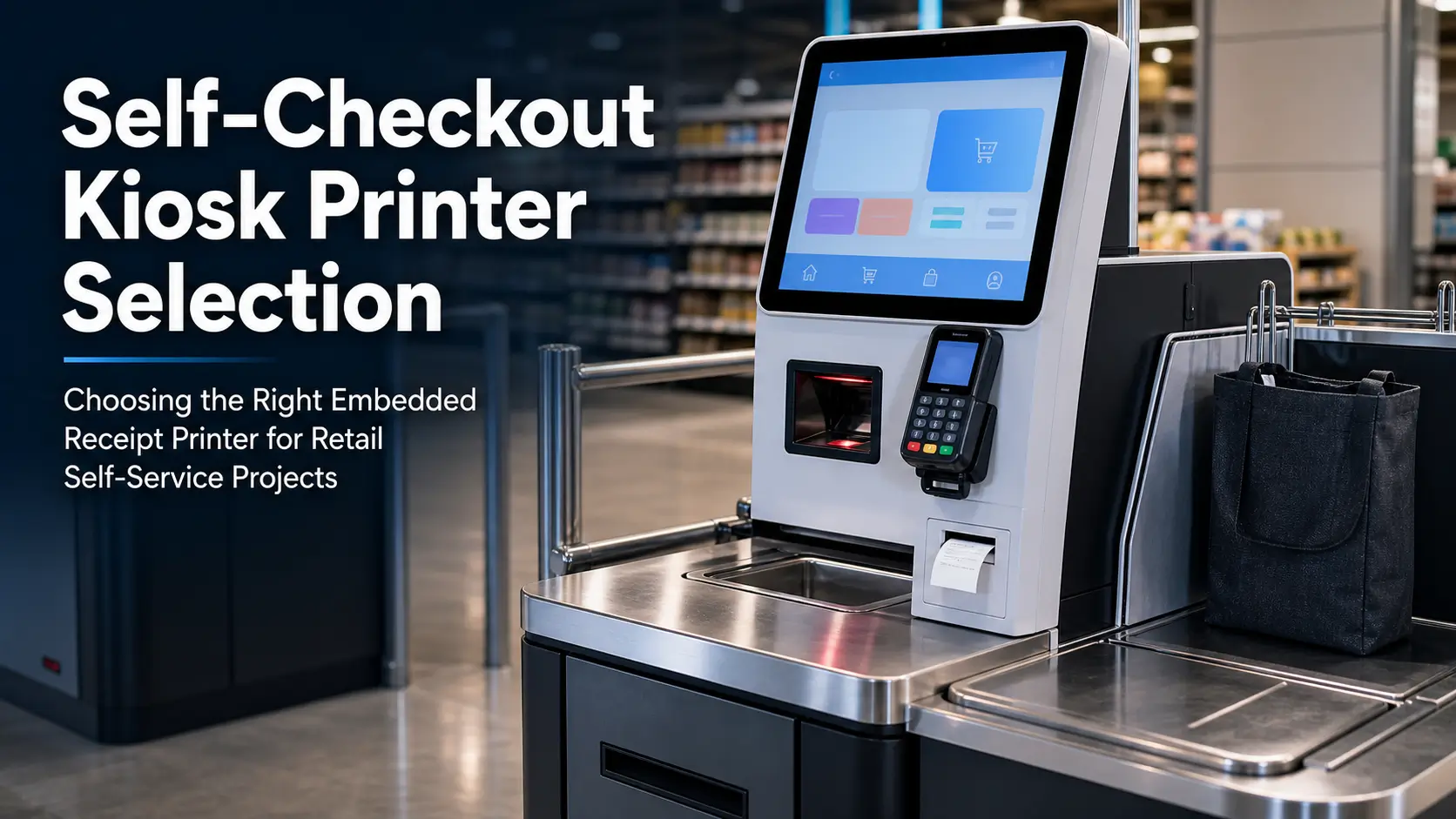
In a self-checkout kiosk, the printer is easy to underestimate.
The customer notices the scanner first. The store team watches payment success. The mechanical team may focus on the screen, scanner window, payment terminal, and cabinet shape.
But during daily operation, the receipt printer can still decide whether the checkout lane feels stable or troublesome.
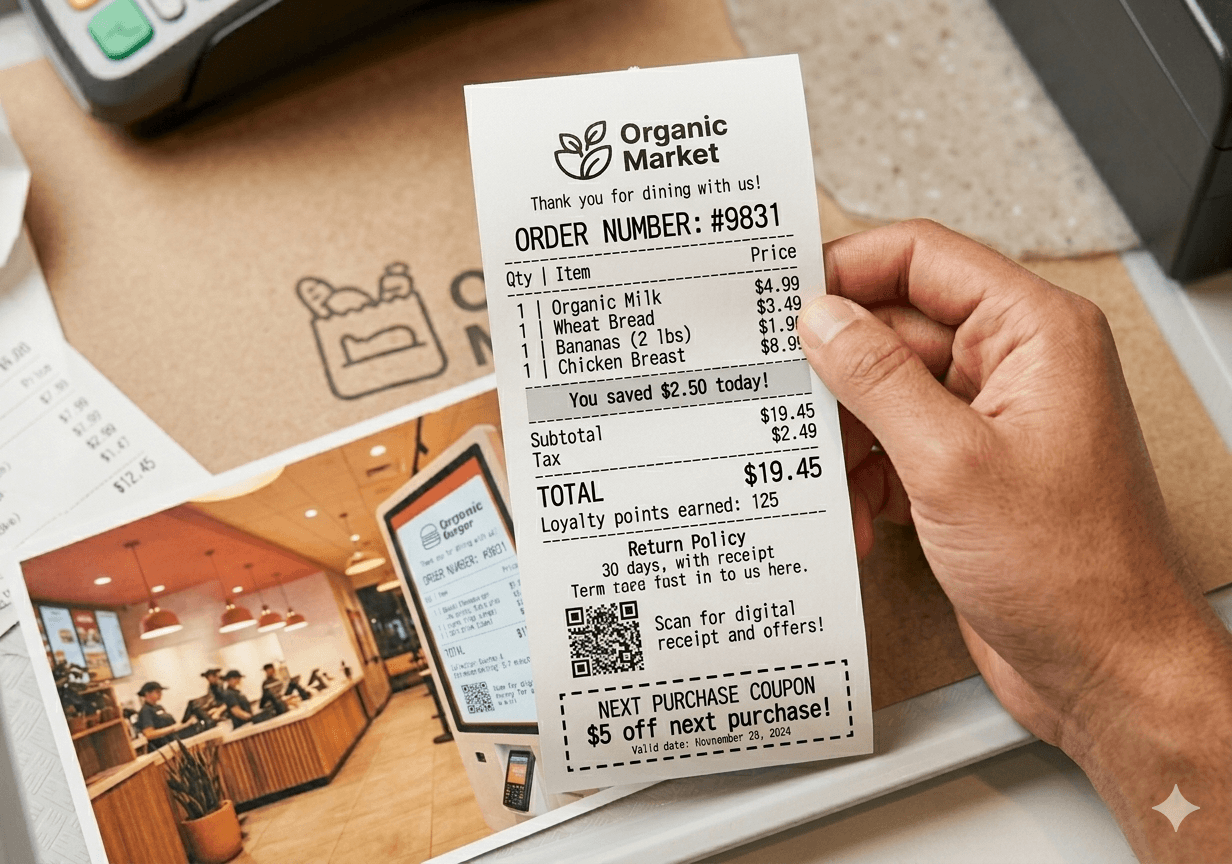
A self-checkout receipt may include item lines, discounts, tax content, payment records, return references, QR codes, store information, and terminal IDs. During peak shopping hours, one paper jam, poor cut, small QR code, or slow paper replacement can pull staff away from the floor.
Self-checkout kiosk printer selection should start from the checkout workflow, not from a printer catalog.
Before the enclosure is locked, the project team should confirm the real receipt layout, cabinet space, output method, interface, status feedback, and service access.
Use this guide as a project-side checklist before prototype testing or multi-store rollout.
It is written for system integrators, kiosk manufacturers, retail technology providers, and OEM solution teams selecting printers for self-checkout kiosk projects.
Quick Answer
For most self-checkout kiosks, an 80mm embedded thermal kiosk printer is the safer starting point. It gives enough room for item lists, payment details, tax lines, QR codes, return references, and store information.
A 58mm or 60mm printer may work only when the terminal prints short payment confirmations, compact pickup references, or very simple transaction slips.
For unattended or high-volume retail checkout, also evaluate whether a presenter kiosk printer is needed. A presenter can help when users pull receipts early, leave receipts behind, or when the project needs more controlled paper output.
Confirm the final choice with real retail data, not sample text.
| Project Condition | Better Printer Direction |
|---|---|
| Full retail receipt with item list | 80mm kiosk printer |
| Receipt with QR code or return reference | Usually 80mm kiosk printer |
| Compact checkout terminal with short slip | 58mm / 60mm compact printer |
| Busy grocery self-checkout lane | 80mm kiosk printer or presenter printer |
| Users may pull receipt before cutting | Presenter kiosk printer |
| Staff must replace paper quickly | Printer with easy paper loading and good service access |
| Multi-store rollout | Printer tested with real receipt data and pilot traffic |
Self-checkout printer selection is one part of a broader kiosk printer integration decision. Paper width, presenter requirement, cutter behavior, driver support, SDK resources, printer status feedback and service access should be reviewed together before the enclosure is finalized.
For a broader overview of embedded kiosk printers, presenter printers, compact printer options and application-based printer selection, visit our Kiosk Printer Hub.
Start With the Checkout Workflow
A self-checkout printer does not work alone. It sits inside a retail transaction flow.
The customer scans items, confirms the basket, applies discounts or loyalty information, completes payment, and receives a printed record. The receipt may also support returns, expense claims, digital receipt lookup, or store audit requirements.
That means the printer must support three sides of the project:
– The customer-facing receipt experience
– The store team’s daily maintenance workflow
– The software team’s integration and monitoring plan
If the printer is selected too late, the project may need to change the receipt outlet, paper roll space, mounting bracket, cable path, service door, driver setup, or receipt layout.
This is why experienced teams confirm the printer before cabinet tooling, not after.
The printer should be evaluated as part of the complete self-checkout hardware system, not as a standalone receipt device. Scanner response, payment confirmation, POS communication, receipt output and store maintenance workflow all affect the final checkout experience.
For broader retail kiosk hardware planning, see our Self-Checkout Hardware Solutions.
What Is a Self-Checkout Kiosk Printer?
A self-checkout kiosk printer is an embedded thermal printer installed inside a retail self-service checkout terminal. It prints the transaction document that connects the customer, store POS system, payment process, and after-sales workflow.
In self-checkout projects, the printer may output:
– Purchase receipts
– Payment confirmations
– Tax records
– Discount and promotion details
– Loyalty references
– QR codes or barcodes
– Return references
– Terminal IDs
– Exception or service records
The printer must fit the kiosk enclosure, match the controller interface, support the operating system, and remain serviceable during daily retail operation.
58mm vs 80mm Kiosk Printer for Self-Checkout
Paper width is one of the first decisions, but it should not be treated as the only decision.
For self-checkout, the receipt usually carries more information than a simple payment slip. Even a small basket can include product names, quantity, discounts, tax, payment method, receipt number, store details, and QR code content.
That is why 80mm is usually the better starting point for full retail checkout receipts.
| Selection Point | 58mm / 60mm Kiosk Printer | 80mm Kiosk Printer |
|---|---|---|
| Best fit | Short confirmations or compact terminals | Full retail checkout receipts |
| Receipt layout | Limited line width, more wrapping | More room for item lists and structured layout |
| QR code room | Limited, must be tested carefully | More layout room for QR codes and return references |
| Basket size | Better for very short transactions | Better for multi-item baskets |
| Cabinet space | Easier for small enclosures | Requires more internal and front-panel space |
| Paper roll planning | Often smaller in compact designs | Better for busy stores if larger rolls are supported |
| Retail use | Simple payment confirmation | Self-checkout receipt, tax record, return reference |
| Project risk | Receipt may become crowded if content grows | Needs more enclosure and service-access planning |
Project manager note: do not decide from a clean demo receipt. Test a receipt with long product names, discounts, tax, QR code, return policy, and store footer.
If the project team is still comparing 58mm, 60mm and 80mm printer directions, the decision should be based on the real retail receipt layout, not only on cabinet space.
For a broader paper-width comparison, see our 58mm vs 80mm kiosk printer selection guide.
Standard Cutter Printer vs Presenter Printer
The second major decision is the output method.
A standard embedded printer prints and cuts the receipt directly at the output slot. This can work well when the self-checkout area is supervised and customers collect receipts normally.
A presenter printer holds the receipt and presents it in a more controlled way. This can help in unattended retail environments or high-volume checkout lanes where early pulling may affect the paper path.
| Selection Point | Standard Cutter Printer | Presenter Kiosk Printer |
|---|---|---|
| Best fit | Supervised or standard receipt output | Unattended or high-volume checkout |
| User behavior | Works when users collect normally | Better when early pulling is a concern |
| Output control | Prints and cuts at the outlet | Holds and presents paper in a controlled way |
| Mechanical design | Usually simpler | Requires more output-slot planning |
| Store operation | Cost-sensitive or standard workflow | Higher-reliability receipt handling |
For self-checkout projects, presenter selection should be discussed before the cabinet drawing is frozen.
It affects output slot design, paper path, jam recovery, service access, and software timing. If receipt collection behavior is uncertain, test both output methods during the prototype stage.
For a deeper comparison, see our presenter printer vs auto cutter printer for self-checkout kiosks.
Architecture and Workflow Layer
A typical self-checkout kiosk printer workflow may look like this:
Barcode scanner -> Checkout software -> Payment terminal -> Embedded kiosk printer -> Industrial controller -> POS or retail management platform
Depending on the project, the kiosk may also include:
– Touchscreen
– Fixed mount barcode scanner
– Scale or weighing module
– Payment terminal
– Receipt printer
– Camera or security module
– Industrial mini PC or Android controller
– Network module
– Remote monitoring software
– Store POS integration
– Loyalty or membership module
The printer should be checked as part of this full hardware architecture.
For example, a printer may fit the cabinet in isolation, but conflict with the scanner bracket, payment cable path, controller position, or service door. A receipt may print correctly in the lab, but the QR code may be too small after the real return reference is added.
In self-checkout systems, scanner performance and receipt output are connected through the same transaction workflow. Product scanning, payment confirmation and receipt printing should be tested together under real checkout conditions.
For scanner-side hardware selection, see our fixed mount barcode scanners for self-checkout product scanning.
What Experienced Integrators Usually Evaluate
Experienced self-checkout teams do not choose a printer only by print speed.
In review meetings, the questions are usually very practical:
– What is the longest receipt the store may print?
– Will the receipt include return QR codes or barcodes?
– Are product names short, long, or multilingual?
– Does the receipt include discounts, tax lines, loyalty references, or coupons?
– Can staff replace paper without moving the kiosk?
– Can the software detect paper-out, cover-open, cutter, or jam events?
– Will customers pull the receipt before cutting is complete?
– Does the printer match the operating system and controller interface?
– Can the same printer choice support pilot testing and rollout?
These questions matter because self-checkout systems operate under real store pressure. A printer that works in a short demo may still create service issues if receipt layout, paper access, output control, or status feedback is not planned.
Deployment Reality
Self-checkout printer projects often look simple in the first prototype.
A sample receipt prints correctly. The scanner works. The payment terminal returns a successful result. The cabinet looks clean.
Field operation is different.
Customers scan quickly. Some baskets contain many items. Receipts may include discounts, loyalty content, tax lines, payment records, QR codes, return references, and store messages. Staff may need to replace paper while several terminals are active.
For rollout projects, test the printer as part of the complete self-checkout workflow. Do not test it only as a standalone printer.
Important deployment checks include:
– Test receipts with real basket data.
– Check QR code and barcode readability.
– Confirm paper replacement time.
– Review output slot alignment.
– Verify printer status feedback.
– Confirm driver and SDK resources early.
– Review mechanical files before cabinet tooling.
– Run pilot tests during realistic store traffic.
Application Scenarios
Grocery Self-Checkout Kiosks
Grocery receipts often include many line items, price changes, discounts, tax lines, loyalty references, and payment details.
For this type of lane, evaluate 80mm first, then confirm paper roll capacity and service access.
Convenience Store Self-Checkout
Convenience store kiosks need fast transaction flow and simple staff maintenance. One staff member may monitor several terminals, so paper replacement and printer status feedback matter.
80mm is usually suitable for full receipts. A compact printer may work only when the receipt is short and the enclosure is very limited.
Retail Self-Service Checkout
Retail self-service checkout terminals may print product lists, return references, warranty information, and QR codes. The printer should support clear output and stable integration with the POS system.
The key risk is future receipt growth. Retail operators often add loyalty messages, promotional lines, or digital receipt links after the first deployment.
Unattended Micro-Market Kiosks
Micro-market and unattended retail kiosks may operate without constant staff supervision. Printer status monitoring becomes more important in this environment.
If users may pull receipts early or leave paper behind, evaluate a presenter printer before the enclosure is finalized.
Pharmacy or Healthcare Retail Checkout
Healthcare retail receipts may include product details, payment references, service records, and sometimes more sensitive customer-facing information.
The printout should be readable. The paper path should also be reliable because staff intervention may interrupt service flow.
How to Choose
1. Confirm the Receipt Content First
Start with the real receipt format. Do not choose the printer only from a hardware catalog.
Check whether the receipt includes:
– Product names
– Quantity and price
– Discounts
– Tax information
– Payment details
– Loyalty references
– QR codes or barcodes
– Return references
– Store and terminal information
If the receipt is long or information-dense, 80mm paper is usually easier to work with.
2. Choose the Paper Width
Use 58mm or 60mm only when the kiosk prints short confirmations or simple transaction slips.
Use 80mm when the kiosk prints full checkout receipts, item lists, tax lines, QR codes, return details, or store footer content.
For most self-checkout kiosks, 80mm gives more layout flexibility and better readability.
3. Decide Whether You Need a Presenter
If the kiosk is supervised and users collect receipts normally, a standard embedded kiosk printer may be enough.
If the kiosk is unattended, high-volume, or affected by early receipt pulling, evaluate a presenter printer before locking the output slot design.
Make this decision before the output slot, service door, and paper path are finalized.
4. Review Cabinet Space and Service Access
The printer must fit inside the kiosk with enough room for:
– Paper roll
– Output path
– Cable routing
– Mounting structure
– Service access
– Jam clearing
– Front or side paper replacement
If staff cannot replace paper quickly, the kiosk may become unavailable during peak store traffic.
5. Confirm Operating System and Interface
Self-checkout kiosks may use Windows, Linux, Android, or embedded controller platforms.
Before selecting the printer, confirm:
– USB, serial, Ethernet, or other interface requirement
– Driver availability
– SDK availability
– Command support
– Printer status feedback
– Compatibility with checkout software
– POS system integration requirements
This step reduces integration risk during prototype testing.
6. Test With Real Retail Data
Sample text is not enough.
Test the printer with real product names, item quantities, discounts, tax lines, payment references, QR codes, and return information.
Also test receipt layouts from different store formats if the kiosk will be deployed across multiple retail chains.
7. Plan for Pilot and Rollout
The printer used in prototype testing should be realistic for future deployment.
Changing the printer later may affect the enclosure, wiring, receipt layout, software, and service workflow.
For multi-location rollouts, use pilot testing to confirm paper consumption, maintenance frequency, receipt collection behavior, and error reporting.
Final Selection Checklist
Before approving a self-checkout kiosk printer, review the following checklist with the mechanical, electrical, and software teams.
| Check Item | Why It Matters |
|---|---|
| Real retail receipt sample | Confirms whether 58mm / 60mm is enough or 80mm is required |
| Longest basket receipt | Tests item names, discounts, tax lines, and footer content |
| QR code or return barcode | Needs enough width, quiet zone, and print clarity |
| Kiosk enclosure structure | Determines embedded printer, compact printer, or presenter direction |
| Output slot position | Must match user collection angle and paper path |
| Paper roll space | Affects refill frequency and store staff workload |
| Paper loading method | Determines whether staff can reload paper quickly |
| Cutter or presenter behavior | Affects receipt collection and early-pull risk |
| Interface | Must match the host controller and checkout software |
| Driver or SDK availability | Reduces integration risk during prototype testing |
| Printer status feedback | Helps software handle paper-out, cutter, or jam events |
| POS integration | Ensures receipt output matches transaction workflow |
| Pilot test result | Confirms performance before multi-store rollout |
Recommended SNRO Kiosk Printer Shortlist
After the receipt width, enclosure design, output method, operating system, interface, paper loading method, and deployment quantity are clear, the shortlist becomes more useful.
SNR-KP800-VX 80mm Kiosk Printer for Self-Checkout Receipt Output
Shortlist SNR-KP800 Series when the self-checkout kiosk needs standard 80mm receipt output for retail checkout kiosks, grocery checkout terminals, convenience store self-service terminals, payment receipt output and POS-connected self-service systems.
SNR-KP802-VX Presenter Kiosk Printer for High-Volume Self-Checkout Kiosks
Shortlist SNR-KP802-VX when controlled receipt output is important, especially for high-volume self-checkout kiosks, unattended retail terminals, micro-market kiosks and projects where receipt collection behavior is uncertain.
SNR-KP805 Kiosk Thermal Printer for Self-Checkout Receipt Printing
Shortlist SNR-KP805 when the project needs a cost-sensitive 80mm printer direction for common self-checkout receipt output, convenience store terminals, payment confirmation terminals or multi-location rollout planning.
SNR-KP602 Series Compact Kiosk Printer for Short Self-Checkout Confirmations
Shortlist SNR-KP602 Series when the self-checkout terminal is compact and the printout is short, such as simple payment confirmations, short transaction records or small-format retail kiosks.
What Successful Deployments Usually Have in Common
Successful self-checkout kiosk printer deployments usually share the same pattern.
The receipt format is confirmed early. The printer is tested with real basket data. The mechanical team checks the cabinet and output slot. The software team confirms driver, SDK, and status feedback. The store operation team checks paper replacement.
These details may look small during planning. In the field, they often decide whether the self-checkout kiosk stays available during busy periods.
Conclusion
Choosing a kiosk printer for a self-checkout kiosk is not only about print speed or price. The printer must match the receipt format, kiosk enclosure, user behavior, software platform, maintenance workflow, and rollout plan.
For many retail self-checkout kiosks, an 80mm embedded thermal printer is the first option to evaluate. For compact terminals, a 58mm or 60mm printer may work if the receipt content is short. For unattended or high-volume deployments, a presenter printer may also be worth testing.
The safest approach is simple: test the printer with real receipt data, the real cabinet structure, and realistic store traffic before mass production.
Related Resources
Main Guides
- Kiosk printer integration knowledge hub
- 58mm vs 80mm kiosk printer selection guide
- Self-payment kiosk printer selection guide
- Food ordering kiosk printer selection guide
Technical Resources
- Kiosk printer SDK and status feedback guide for self-checkout systems
- Linux kiosk printer integration guide for retail self-checkout systems
- Maintenance accessibility for self-checkout kiosk hardware
- Drivers, SDKs and technical downloads for kiosk printer integration
Related Product Resources
- 80mm kiosk printer resources for retail receipt output
- Presenter kiosk printer resources for controlled receipt delivery
Related Products
- SNR-KP800-VX 80mm kiosk printer for self-checkout receipt output
- SNR-KP802-VX presenter kiosk printer for high-volume self-checkout kiosks
- SNR-KP805 kiosk thermal printer for self-checkout receipt printing
- SNR-KP602 compact kiosk printer for short self-checkout confirmations
Related Solutions
- Self-checkout hardware systems for retail transaction workflows
- Queue management hardware for retail service flow
FAQ
What printer is best for a self-checkout kiosk?
For many self-checkout kiosks, an 80mm embedded thermal kiosk printer is the first option to evaluate. It provides enough width for item lists, payment details, tax information, QR codes, and return references.
Is a 58mm printer enough for self-checkout receipts?
A 58mm or 60mm printer may be enough for short confirmations or simple tickets. For full retail checkout receipts, 80mm is usually more readable and flexible.
Should a self-checkout kiosk use a presenter printer?
A presenter printer may be useful when the kiosk is unattended, high-volume, or affected by users pulling receipts early. It should be evaluated together with the output slot and software workflow.
What should be tested before choosing a self-checkout printer?
Test real receipt data, longest basket receipts, QR code readability, paper loading, cutter or presenter behavior, driver support, SDK support, printer status feedback, and pilot operation under realistic store traffic.
What operating systems should a self-checkout kiosk printer support?
The printer should match the kiosk controller and checkout software. Many projects need Windows, Linux, Android, or embedded controller support, depending on the system architecture.
Why is printer status monitoring important?
Printer status monitoring helps the software detect paper-out, cover-open, cutter, or jam events. This is useful for unattended or multi-terminal retail deployments where staff need fast error visibility.
How should retailers plan paper replacement for self-checkout kiosks?
Plan paper replacement around real transaction volume, paper roll capacity, service door access, and staff workflow. In busy stores, the printer should allow staff to replace paper quickly without moving the kiosk or disturbing nearby devices.
Which SNRO printer models can be considered for self-checkout kiosk projects?
For standard 80mm receipt output, consider SNR-KP800 Series. For controlled paper presentation, evaluate SNR-KP802-VX. For cost-sensitive 80mm output, consider SNR-KP805. For compact short-receipt workflows, evaluate SNR-KP602 Series.
Can SNRO recommend a printer for a self-checkout kiosk project?
Yes. SNRO can review the receipt format, kiosk structure, interface requirement, operating system, paper loading direction, and expected deployment environment to recommend a practical printer for testing.
Need Help Choosing a Printer for Your Self-Checkout Kiosk?
If you are designing a grocery self-checkout kiosk, convenience store terminal, retail self-service checkout machine, micro-market kiosk, pharmacy checkout kiosk, or multi-store checkout rollout, SNRO can help review your printer direction before prototype testing.
Share your receipt sample, basket size, QR or return barcode requirement, cabinet layout, output method, operating system, interface, paper loading direction and expected daily transaction volume. Our team will recommend a suitable 80mm, compact or presenter kiosk printer for your self-checkout deployment.